English
 Español


Article Directory
- 1 What Air Covered Yarn Is, and What It Deliberately Is Not
- 2 Inside the Air-Jet Nozzle: Four Settings That Decide the Stretch
- 3 Denier, Draw Ratio and Overfeed: The Numbers That Decide Comfort
- 4 Comfort Is Measurable: Recovery, Growth and Air Permeability
- 5 Sourcing Air Covered Yarn: What to Verify Before You Commit
- 6 Answers from the Production Floor
Air covered yarn (ACY) exists to solve one specific industrial problem: how to deliver reliable elasticity in a fabric that still feels soft, light and dimensionally stable after dyeing, washing and repeated wearing. It does that by combining two very different filaments into a single structure and holding them together with air instead of twist.
Knowing what that structure can and cannot do is the difference between a programme that holds its fit through twenty wash cycles and one that starts sagging after three.
What Air Covered Yarn Is, and What It Deliberately Is Not
Air covered yarn is a composite elastic yarn in which a bare elastane core is wrapped by one or two filament yarns and locked in place by compressed-air interlacing rather than by twisting. Three variables define the yarn that reaches the knitting machine: core denier, sheath filament and interlacing density.
The absence of twist is the whole point. A twisted covering, known as single covered yarn (SCY), holds its core with a helical wrap that restricts core movement and produces a firmer, snappier hand. Air covering leaves the core free to extend and recover inside a soft sheath, which is why ACY dominates activewear, seamless knitwear and medical compression fabrics where comfort matters more than maximum power. The structural trade-offs between the two yarns are set out in this comparison of ACY and SCY in seamless activewear.
- Stretch level: moderate and stable, normally 120% to 250% elongation at break on the composite yarn, against 180% to 350% for a comparable SCY.
- Hand feel: soft and dry, because the sheath filament covers the elastane completely and no twist ridge forms on the surface.
- Production economics: air covering runs at 400 to 700 metres per minute, roughly three to five times the output of a ring twisting covering spindle.
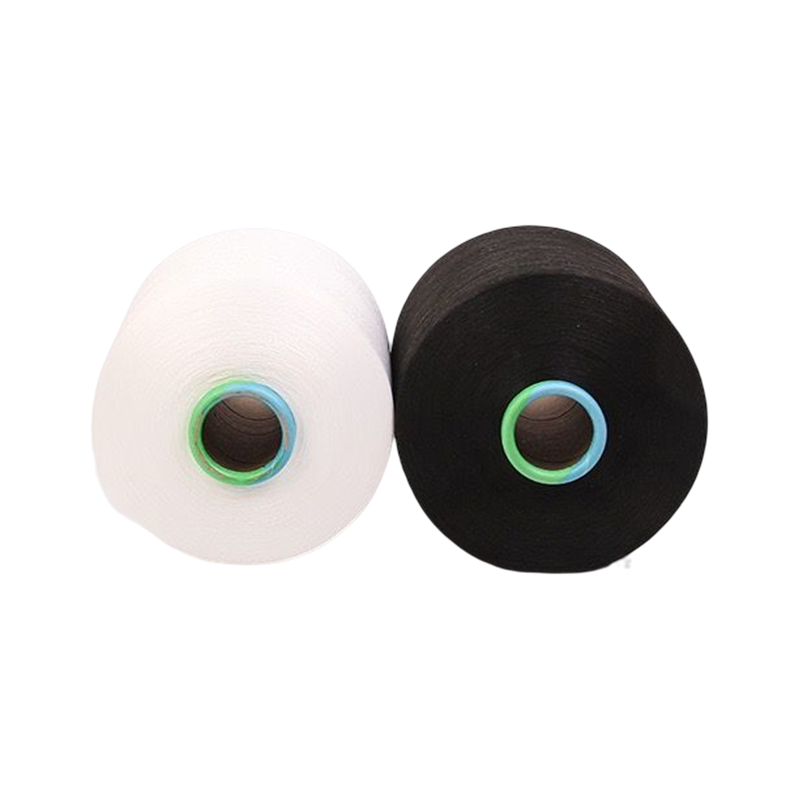
 Air Covered Yarn for Soft Stretch Activewear and Seamless KnitsSpandex-core air-covered yarn with polyester DTY sheath, available in white or black, offering torque-free stretch recovery for activewear, seamless knitwear, and compression fabrics.View Product →
Inside the Air-Jet Nozzle: Four Settings That Decide the Stretch
Roughly 90% of the stretch a buyer eventually feels in the finished fabric is fixed by four settings at the covering spindle: elastane draw ratio, sheath overfeed, nozzle air pressure and take-up tension. Getting three of them right is not enough.
Denier, Draw Ratio and Overfeed: The Numbers That Decide Comfort
Comfort can be specified far more precisely than most order sheets allow, because every comfort attribute maps to one measurable parameter window. The table below shows the ranges used on commercial air-jet covering machines.
| Parameter | Typical working range | Comfort effect | Failure mode outside the range |
| Elastane core denier | 20D to 40D, or 22 to 44 dtex | Sets maximum stretch and recovery speed | Below 20D, yarn breaks in knitting; above 40D, fabric turns heavy and low stretch |
| Core draw ratio | 2.5x to 4.0x | Sets residual elongation and growth after washing | Below 2.5x, growth exceeds 5%; above 4.0x, snagging and a hard hand |
| Sheath overfeed | 10% to 30% | Sets bulk, softness and core coverage | Below 10%, the elastane shows through; above 30%, loops snag and pill |
| Nozzle air pressure | 0.3 to 0.6 MPa | Sets interlacing density, usually 60 to 100 nips per metre | Too low, the sheath slips; too high, filaments fracture and ends break |
| Sheath filament | 30D to 150D polyester or nylon | Sets surface hand, lustre and dyeing behaviour | Shrinkage mismatch with the core produces cockled fabric after heat setting |
Comfort Is Measurable: Recovery, Growth and Air Permeability
Stretch and comfort can be verified with three tests, and all three belong in a purchase specification. Fabric growth after repeated elongation is the single best predictor of whether a garment will sag.
On the yarn side, ISO 2062:2013 defines how single-end breaking force and elongation at break are measured on a constant rate of extension tester, which is how a claimed elongation of 180% is confirmed rather than assumed. On the fabric side, ASTM D2594 covers the stretch properties of knit fabrics and measures growth after repeated cycling. Air permeability tested to ISO 9237 and water vapour resistance tested to ISO 11092 complete the comfort picture for activewear, because a fabric that stretches well but cannot breathe will still be rejected by the wearer.
Sourcing Air Covered Yarn: What to Verify Before You Commit
Three checks prevent nearly every ACY quality dispute: a written draw ratio and overfeed window instead of a single value, a growth test run on dyed fabric instead of greige, and a supplier whose colour range and delivery capacity can actually be verified.
Colour earns its own line in the specification, because the sheath filament is what the customer actually sees. A programme that switches filament lots without a fixed reference will show shade banding inside a single roll. Ordering against a defined reference, such as a published colour card with numbered shades, keeps the stretch identical while holding the surface colour constant.
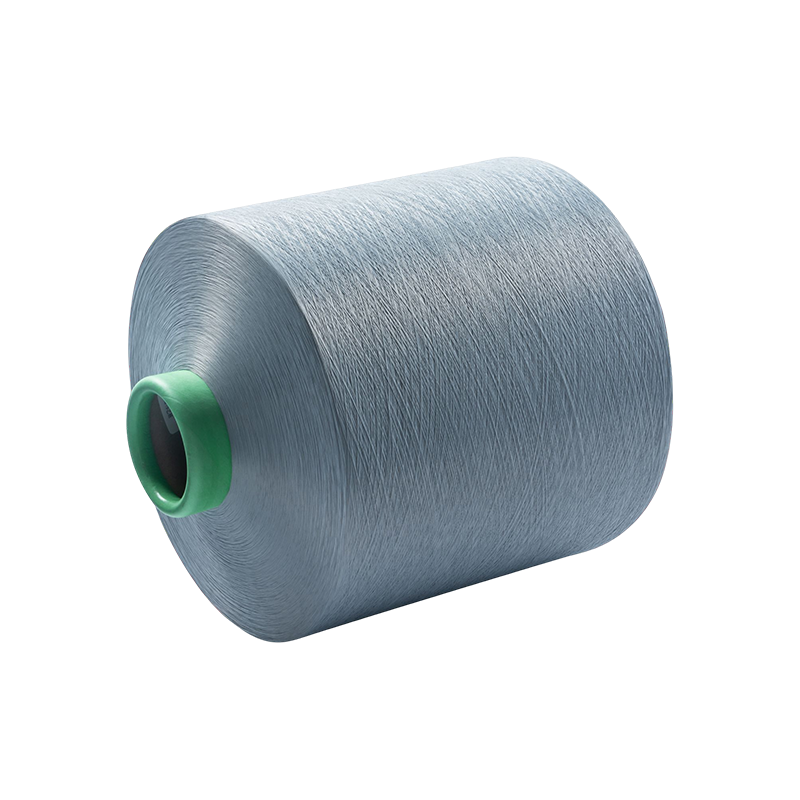 Silver Series Full-Color Custom Polyester DTY Yarn121 denier textured yarn with stable silver luster, high intermingling, and tight dye-lot consistency for sportswear, underwear, home textiles, and upholstery.View Product →
- Request a 5 kg sample of the exact core and sheath combination, not a generic ACY sample from stock.
- Knit, dye and wash the sample under production conditions, then measure growth to ASTM D2594.
- Compare measured growth with the claimed value before releasing the bulk order.
- Confirm the delivery window in writing; a 20 day window after order confirmation is realistic when the shade already exists in inventory.
Answers from the Production Floor
What elastane core denier suits a 180 gsm stretch knit?
For a 180 to 220 gsm single jersey, a 30D to 40D core with 8% to 12% elastane content gives the best balance of recovery and comfort after dyeing. A 20D core belongs in lightweight fabrics below 150 gsm, where the lower mass keeps the hand soft, but it leaves little margin for tight stitch densities above 28 gauge.
Why does stretch fall after dyeing?
Polyester dyeing in a pressurised jet at about 130 degrees Celsius is safe for elastane when exposure is controlled, but dry heat setting above 190 degrees Celsius for longer than 45 seconds starts to degrade the core. If a lot loses more than 10% of its pre-dye elongation, the heat setting conditions, not the covering machine, are usually responsible.
How is ACY stretch verified before bulk production?
Two tests cover it. ISO 2062:2013 confirms yarn breaking force and elongation at break on the package, and ASTM D2594 confirms growth and recovery on the finished knit. Most apparel programmes accept a maximum growth of 5% after three cycles to 80% elongation, and ask for the report per dye lot rather than per season.
What should a buyer confirm about supply before ordering?
Confirm four figures: annual capacity, minimum order quantity per shade, the delivery window counted from order confirmation, and whether the supplier tests in house. A supplier able to state 300,000 tons of annual capacity and a 20 day delivery window, backed by its own laboratory, removes most of the risk that colour or stretch will drift between shipments.