English
 Español


Article Directory
- 1 Denier Sets the Fabric Weight Ceiling Before Anything Else Is Discussed
- 2 Filament Count and dpf Decide Hand Feel, Cover and Luster
- 3 Matching the Specification to the Fabric and the Machine
- 4 The Four Test Numbers That Decide Whether a Bulk Lot Is Approved
- 5 Colour Method, Minimum Order Quantity and Lead Time
- 6 Questions Buyers Ask Before Approving a DTY Specification
Every DTY quotation that lands in your inbox is compressed into three numbers: 150D/48F, 300D/96F, 75D/72F. Two yarns built from the same polyester chip, the same colour and the same denier can behave like different materials on the same machine, because the filament count decides how that mass is divided across the cross-section.
This guide works through the three selection variables in the order experienced buyers use them: denier first, filament count second, fabric requirement third. It then covers the four test numbers that decide whether a bulk lot is worth approving, and how colour method and minimum order quantity reshape the real cost of a programme.
Working definition: DTY (draw textured yarn) is a continuous-filament polyester yarn that has been drawn and false-twist textured to give it bulk, stretch and a matte hand. Its specification is written as denier/filament count, for example 150D/48F, where 150 is the linear density in grams per 9,000 metres and 48 is the number of filaments in the yarn cross-section.
Denier Sets the Fabric Weight Ceiling Before Anything Else Is Discussed
Denier is the linear density of the yarn expressed in grams per 9,000 metres and measured on a conditioned skein to ISO 2060; it is the first filter in selection because it fixes the fabric weight the yarn can reach, and a 150D yarn will not knit into a 90 gsm single jersey no matter how the machine is tuned.
The relationship is close to linear on a fixed machine setting. Denier and grams per square metre move together, so a 3% denier drift on a 150D yarn shows up as roughly 3% in greige fabric weight before finishing shrinkage is counted. That is why denier belongs in the purchase contract rather than in an estimate taken from a hand sample.
Contract specifications for apparel DTY normally hold linear density within plus or minus 3% of nominal, and the value has to be measured under the standard textile atmosphere of 20 plus or minus 2 degrees Celsius and 65 plus or minus 4% relative humidity defined in ISO 139. A test certificate quoting denier measured in an uncontrolled warehouse is not evidence of anything.
Moving up in denier
Heavier fabric at the same stitch density, better tear and abrasion resistance, lower yarn cost per kilogram, but a stiffer hand, slower machine throughput and fewer stitches per centimetre.
Moving down in denier
Finer hand, faster drape, more filaments packed into the same mass, but a higher yarn price per kilogram and a narrower process window before thin spots appear in the greige.
Reading a denier tolerance clause
A plus or minus 3% clause on a 150D yarn legally allows 145.5D to 154.5D. Before signing, ask what the mill's process capability is. If the spinning line runs at plus or minus 1.2%, the clause never triggers and fabric weight stays flat across lots. If it runs at plus or minus 2.8%, every shipment sits on the limit, and the tolerance number matters far less than the mill's ability to stay well inside it.
Filament Count and dpf Decide Hand Feel, Cover and Luster
dpf is denier divided by filament count, so 150D/48F runs at 3.1 dpf while 150D/144F runs at 1.0 dpf. That single ratio changes bending stiffness, cover and light reflection more than any dyeing or finishing step downstream, which is exactly why filament count is the second number a careful buyer checks.
- Above 4.0 dpf: crisp and papery with high bulk, used for woven shells, bag panels and webbing
- 3.0 to 4.0 dpf: the standard apparel band, best for structured knits and warp knits
- 2.0 to 3.0 dpf: balanced softness and body, the workhorse range for circular knit tops
- 1.0 to 2.0 dpf: soft and drapey with faster dye uptake per unit mass, watch pilling on loose knits
- Below 1.0 dpf: microfibre territory, peach-skin and suede effects, highest cost and highest barre risk
Filaments per cross-section at 150 denier and the resulting dpf
Cross-section shape compounds the effect. A trilobal filament reflects light from three flat faces, so a 150D/48F trilobal bright yarn reads visibly glossier than a round 150D/48F at an identical dpf, and the same geometry hides soil better in carpet and upholstery.
Filament count also steers dyeing behaviour. Doubling filament count at a fixed denier roughly doubles the accessible surface area per unit mass, so dye uptake accelerates and shade reproducibility depends on the filament count staying inside its tolerance band from lot to lot.
Matching the Specification to the Fabric and the Machine
Fabric weight, stretch direction and machine gauge, in that order, turn a yarn catalogue into a workable shortlist. A 24-gauge circular knitting machine running 0.4 mm needle hooks will not tolerate much above 3.5 dpf without needle deflection and barre marks, so a coarse high-bulk yarn that looks ideal on paper is simply the wrong input for that machine.
| Fabric and target weight | Construction and gauge | Starting specification | Why it works |
| Single jersey t-shirt, 150 to 170 gsm | Circular knit, 24 to 28 G | 150D/48F | 3.1 dpf gives bulk without the papery hand of a 36-filament yarn |
| Interlock and pique, 200 to 240 gsm | Circular knit, 24 G | 150D/96F | 1.6 dpf packs more filaments into the same mass, improving cover and reducing grin-through |
| Rib cuff and collar | Rib knit, 18 to 20 G | 300D/96F | 3.1 dpf with the mass needed for shape recovery after repeated stretching |
| Sportswear and compression wear | Warp knit or circular knit with 40D elastane | 75D/72F | 1.0 dpf keeps the hand smooth at a low fabric weight |
| Softshell and bag panels | Woven plain or twill | 300D/72F high tenacity | 4.2 dpf combined with tenacity above 5.5 cN/dtex for tear strength |
| Woven labels and embroidery | Woven label loom, 50 to 100 picks per cm | 100D/36F trilobal bright | 2.8 dpf with three flat faces delivers luster and fine line definition |
| Automotive and industrial textiles | Woven, coated or laminated | 500D to 1000D | Tenacity above 6.0 cN/dtex for abrasion and load bearing |
A colour-matched sample is the shortest route to certainty here. Zhejiang Hengke Textile Technology Co., Ltd. supplies colour-graded DTY across this denier and filament range from its Hangzhou base, and its standard polyester DTY range is organised so that a buyer can pull the same colour in more than one specification before committing.
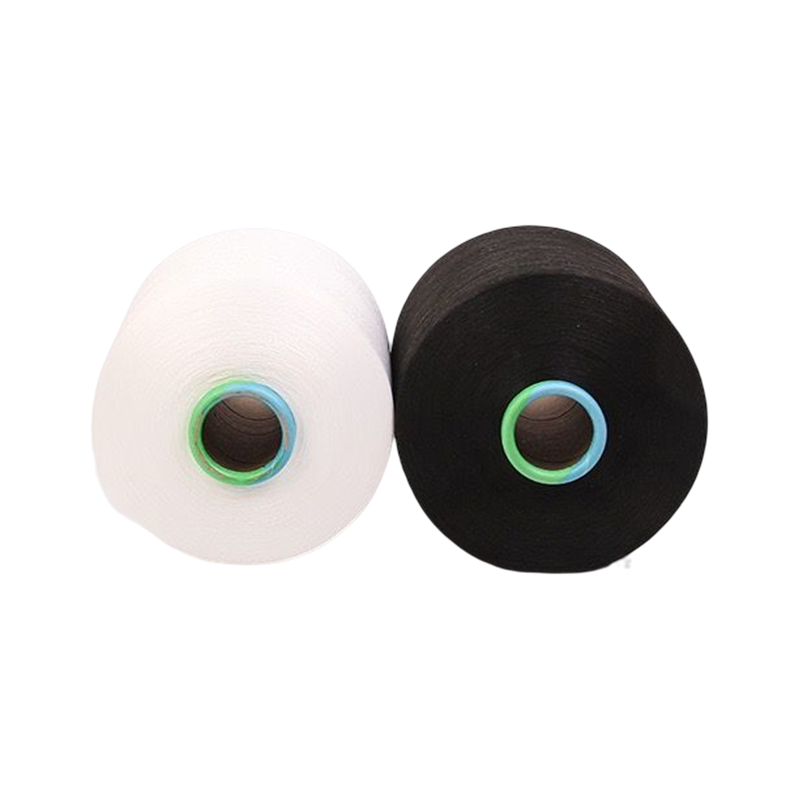
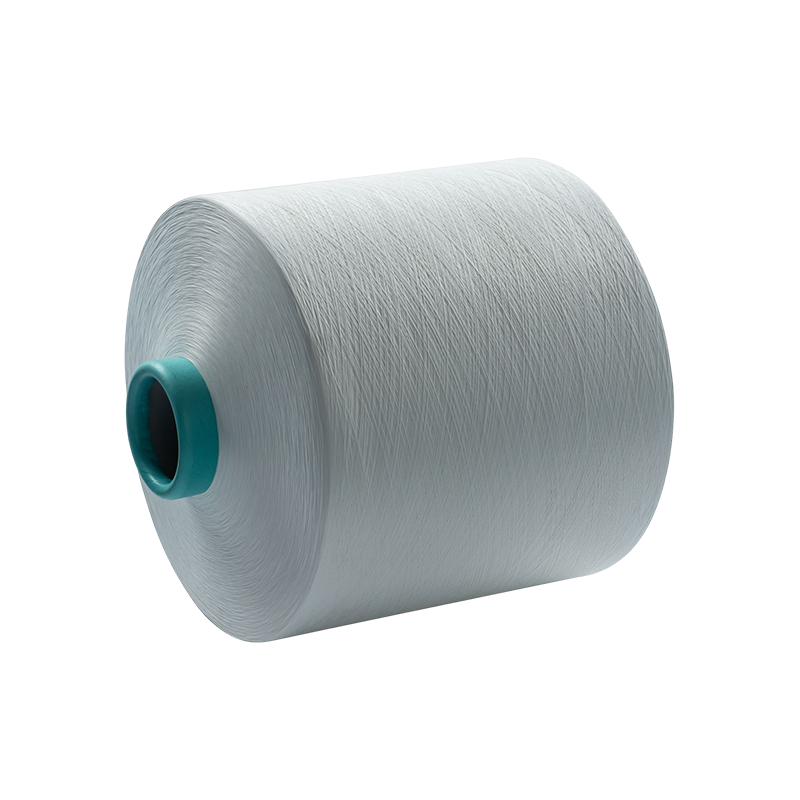 Antibacterial Anti-Odor Polyester DTY Yarn in White and GreyColour-graded DTY with antibacterial and anti-odor properties, available in white and grey shades for buyers comparing multiple specifications before sampling.View Product →
A 30 cm knitted tube, scoured and washed at 60 degrees Celsius, tells you more in 24 hours than three specification sheets. Ask for the shrinkage figure on that same tube, because a 150D/48F that shrinks 5% in boiling water will knit to a different finished weight than one at 2.5%, even though both carry the same label.
For narrow elastic tape, compression bands and waistbands, the stretch component usually comes from an air-covered yarn rather than from DTY alone, and that is where a second yarn type enters the bill of materials.
 Air Covered Yarn with Spandex Core in White and BlackElastic air-covered yarn combining spandex with polyester DTY, suited to stretch tapes, activewear, and garments needing torque-free recovery.View Product →
The Four Test Numbers That Decide Whether a Bulk Lot Is Approved
Tenacity, elongation at break, linear density CV% and hot-water shrinkage are the four figures that separate a bulk approval lot from a beautiful sample. Standard apparel DTY is quoted at 3.5 to 4.5 cN/dtex tenacity with 20 to 30% elongation at break, measured to ISO 2062 on conditioned packages.
| Parameter | Typical acceptance range | Test condition | Risk when out of band |
| Tenacity | 3.5 to 4.5 cN/dtex apparel; 5.5 to 6.5 cN/dtex high tenacity | ISO 2062, 500 mm gauge, 500 mm per minute | Yarn breaks and needle damage at high knitting speed |
| Elongation at break | 20 to 30% | ISO 2062, same specimen as tenacity | Below 18% the yarn turns brittle; above 35% the fabric loses dimensional stability |
| Linear density CV% | Below 1.0% excellent; 1.0 to 2.0% acceptable | ISO 2060, ten packages per lot | Above 2.0% the lot carries a real barre risk after dyeing |
| Hot-water shrinkage | 2.0 to 4.0% | Water at 95 degrees Celsius for 30 minutes | Above 5% the finished gram weight and stitch density drift |
ISO 2062 requires tensile testing on yarns conditioned in the standard atmosphere of 20 plus or minus 2 degrees Celsius and 65 plus or minus 4% relative humidity. Results produced in an uncontrolled sample room cannot be compared between two suppliers, however similar the numbers look on paper.
Barre is the failure these numbers predict. A 1% swing in linear density between two feed packages is enough to shift dye uptake and print visible stripes down a jersey panel after dyeing, and once those stripes are in the fabric no finishing route removes them. That is why CV% belongs in the approval conversation alongside tenacity, not in a footnote.
Colour Method, Minimum Order Quantity and Lead Time
Dope-dyed DTY holds shade consistency at a colour difference around Delta E 1.0 or below between lots because the pigment is compounded into the polymer before spinning, while package-dyed yarn depends on dye-bath control and typically lands nearer Delta E 1.5 to 2.0.
- Dope-dyed: masterbatch pigment enters the melt, no dyeing step is needed, the finishing route shortens, but the shade must be committed to a minimum spin volume before the first metre is produced
- Package-dyed: smaller lots and closer matching to a submitted swatch, but a dyeing and drying cycle is added and with it a new source of shade variation
Colour is also the fastest way to find out whether a supplier holds stock or only promises it. Zhejiang Hengke Textile Technology Co., Ltd., a polyester DTY and ACY yarn supplier based in Hangzhou with a stated annual capacity above 300,000 tons and a delivery window of 20 days after order confirmation, organises its yarn by colour family through its full color card: beige, blue, brown-curry, gray, green, orange-yellow, pink, purple and red. A supplier who can show ten shades of the same denier and filament count is a supplier who can hold a colour programme across a season.
 High-Performance Brown Polyester DTY Yarn ZN0085 FMBrown polyester DTY yarn offering high strength, elasticity, and colour consistency for apparel, home textiles, and industrial fabric applications.View Product →
Two questions settle most colour negotiations. First, what is the minimum spin volume per shade for a dope-dyed run. Second, what is the shade tolerance across consecutive lots rather than across the first two lots. Write both answers into the purchase order next to the denier and the filament count, and the specification is complete.
Questions Buyers Ask Before Approving a DTY Specification
What dpf should a 150 denier DTY yarn have for soft knitwear?
Between 1.0 and 1.6 dpf, which means 150D/96F through 150D/144F. Below 1.0 dpf the yarn enters microfibre territory and you pay a premium for a hand most single jersey programmes cannot justify, while above 2.0 dpf the fabric reads crisp rather than soft after a 60 degree Celsius wash.
How many filaments does a 300D DTY yarn need for woven outerwear?
72 to 96 filaments, giving 3.1 to 4.2 dpf. That band delivers the tear and abrasion resistance a softshell or bag panel needs while staying within the capability of a standard water-jet loom, and it keeps the yarn above 5.5 cN/dtex tenacity without moving into industrial deniers.
What denier tolerance should be written into a DTY purchase contract?
Plus or minus 3% of nominal, measured to ISO 2060 on skeins conditioned to ISO 139 at 20 plus or minus 2 degrees Celsius and 65 plus or minus 4% relative humidity. Tighter than plus or minus 2% is achievable on modern spinning lines, but it rarely changes finished fabric weight enough to justify the price.
How do you verify filament count before bulk production?
Count filaments on a cross-section under a projection microscope or an image-analysis system, five specimens per lot, and compare the result against the mill's test report. Filament count is not visible to the eye and not detectable by touch, yet a change from 48F to 36F at the same denier moves dpf from 3.1 to 4.2, which is enough to shift the hand of a finished knit.