English
 Español


Article Directory
- 1 What Recycled Polyester DTY Yarn Is, and Where It Differs From Virgin DTY
- 2 The Measured Sustainability Case: Carbon, Water and Diverted Bottles
- 3 Performance Parity: What Recycled DTY Matches and What It Does Not
- 4 Colour Control Is the Variable That Decides Whether a Lot Ships
- 5 Sourcing Checklist: Seven Checks Before You Confirm a Recycled DTY Order
- 5.1 Scope certificate and transaction certificate
- 5.2 Input stream declaration
- 5.3 Flake viscosity, moisture and contamination data
- 5.4 Yarn test report against ISO methods
- 5.5 Lab dip approval under three light sources
- 5.6 Shipment sample and acceptance quality limit
- 5.7 Lead time, including documentation lead time
- 6 Where Recycled DTY Pays Off in Production
- 7 Direct Answers on Cost, Substitution and Certification
A confirmed order for 20 tonnes of 150D/48F recycled polyester DTY can leave a mill in Zhejiang within 20 days of order confirmation, and that dispatch window has become the working benchmark for buyers restocking a knitting floor. The number hides the harder half of the story: a recycled yarn lot is only as defensible as the transaction certificate that trails it from bale to beam.
Recycled polyester DTY is where that chain either holds or breaks. It is the yarn that carries recovered polyethylene terephthalate (PET) out of a baling station and into a knitted or woven fabric, and it is also the point where every impurity in the input stream, whether a PVC label, a polylactic acid (PLA) bottle or a stray colour, turns into a filament break on the texturing machine. Understanding the material and the paperwork in that order is what separates a smooth substitution from a rejected shipment.
What Recycled Polyester DTY Yarn Is, and Where It Differs From Virgin DTY
Recycled polyester DTY is a false-twist textured continuous filament yarn melt-spun from recycled PET rather than from virgin purified terephthalic acid (PTA) and monoethylene glycol (MEG), and it is tested against the identical ISO methods used for virgin DTY.
The texturing step is unchanged. Draw-textured yarn (DTY) is produced by running partially oriented yarn (POY) across a false-twist spindle, which inserts crimp, bulk and elastic recovery into a flat filament. In a recycled line, that POY is melt-spun from washed recycled PET flake, and from the spinning head onward the machinery, the draw ratio controls and the quality gates are the same hardware a virgin line uses. The difference sits entirely upstream, in where the polymer came from and how clean it is.
Two recycling routes feed the market, and they behave very differently in production:
- Mechanical recycling washes, sorts and flakes post-consumer bottles, then re-melts the flake. It accounts for the overwhelming majority of recycled polyester fibre, and it cannot remove pigments, delustrants or mixed-polymer contamination.
- Chemical recycling depolymerises PET back to monomer or to bis(2-hydroxyethyl) terephthalate (BHET) through glycolysis, methanolysis or enzymatic routes, then repolymerises it to fibre-grade or bottle-grade quality.
- Hybrid routes blend recycled flake with a virgin chip stream to hit a target intrinsic viscosity, which is common in yarns above 300D where melt strength matters.
Draw-textured yarn (DTY): a continuous filament yarn that has been false-twist textured to introduce crimp, bulk and elastic recovery. Recycled DTY applies that same texturing step to POY spun from recycled PET flake, so linear density, tenacity and shrinkage are measured with the same instruments, in the same conditioning atmosphere defined by ISO 139.
The Measured Sustainability Case: Carbon, Water and Diverted Bottles
Mechanically recycled polyester fibre carries a cradle-to-gate footprint of roughly 1.0 to 1.5 kg CO2e per kilogram, against 2.5 to 3.0 kg CO2e per kilogram for virgin PET filament, a reduction of 45 to 60 percent.
The saving comes from the step that disappears. Virgin polyester starts with refining crude oil to paraxylene, oxidising it to PTA and reacting it with MEG at high temperature and pressure. Recycled polyester starts with a washed flake that is dried and melted. Life-cycle datasets aggregated in the Higg Materials Sustainability Index place mechanically recycled PET filament well below the virgin route, and the exact figure is dominated by the electricity grid serving the spinning plant, not by the recycling process itself. A recycled line running on a coal-heavy grid can land close to a virgin line running on hydro power.
One kilogram of recycled polyester yarn keeps between 35 and 70 half-litre PET bottles out of landfill. A 500 mL bottle carries 15 to 30 grams of PET resin, and flake production yields 85 to 90 percent of the input mass, which sets the range.
Water follows the same logic. Washing flake consumes roughly 2 to 5 litres per kilogram, while conventional exhaust dyeing of polyester fabric consumes an estimated 70 to 150 litres per kilogram. Solution-dyed recycled yarn removes the dye bath altogether, which is why the water argument for recycled polyester is strongest when the colour is added in the melt rather than at the dye house.
Performance Parity: What Recycled DTY Matches and What It Does Not
Between 75D and 300D, recycled DTY matches virgin DTY on tenacity, elongation at break and boiling water shrinkage within normal test tolerance. What separates an accepted lot from a rejected one is intrinsic viscosity, residual contamination and dye uptake consistency, not tensile strength.
The table below reflects typical commercial ranges for mechanically recycled DTY supplied against virgin fibre-grade chip. Buyers who specify only denier and colour and skip the input data are the ones who discover the difference on the knitting floor.
| Property | Virgin polyester DTY | Recycled polyester DTY | Test method |
| Linear density | 150D, plus or minus 2 percent | 150D, plus or minus 3 percent | ISO 2060 |
| Tenacity at break | 3.6 to 4.2 cN/dtex | 3.4 to 4.0 cN/dtex | ISO 2062 |
| Elongation at break | 22 to 32 percent | 20 to 32 percent | ISO 2062 |
| Boiling water shrinkage | 2.5 to 4.0 percent | 3.0 to 5.0 percent | ISO 139 conditioning, in-house test |
| Input intrinsic viscosity | 0.62 to 0.66 dl/g | 0.76 to 0.84 dl/g | ASTM D4603 |
| Colour fastness to laundering | Grade 4 to 5 | Grade 4 to 5, solution-dyed | ISO 105-C06 |
Bottle-grade flake arrives with an intrinsic viscosity of 0.76 to 0.84 dl/g when measured by ASTM D4603, against 0.62 to 0.66 dl/g for fibre-grade virgin chip. Higher intrinsic viscosity raises melt viscosity and the achievable tenacity ceiling, but it narrows the spinning window. A spinner that runs the same melt temperature profile on recycled and virgin chip will see a higher broken-filament count on the recycled lot. Buyers who want a full comparison of where the two streams diverge in efficiency terms can review this virgin versus recycled DTY efficiency analysis before writing a specification.
Colour Control Is the Variable That Decides Whether a Lot Ships
Colour variation, not tensile strength, is the most frequent reason a recycled DTY lot is rejected at fabric inspection, and solution-dyed yarn removes the cause by adding pigment to the polymer melt instead of to a dye bath.
The mechanism is straightforward. Bottle flake arrives mixed, and near-infrared sorting separates clear and light blue material from the rest. Bright shades must come from near-clear flake; darker shades can absorb the tint of mixed feedstock. That is why a recycled yarn range is normally organised as a colour card rather than as a Pantone-matching service. Zhejiang Hengke Textile Technology Co., Ltd., trading as Hengke Textile, structures its DTY catalogue exactly that way, grouping production numbers by colour family, and the green section of the colour card alone spans dozens of item codes across several catalogue pages.
 Anti-Wrinkle Antibacterial Polyester DTY Yarn Green Series ZG0136 Grass GreenGreen-series draw-textured polyester yarn with eco-pigment, antibacterial and wrinkle-resistant properties, offered in a catalogue colour family for durable green textile applications.View Product →
Fastness is not the compromise buyers assume it to be. Solution-dyed recycled polyester typically reaches grade 4 to 5 on ISO 105-C06 laundering and grade 6 or better on the ISO 105-B02 blue wool light scale, because the pigment is locked inside the filament rather than adsorbed onto its surface. Package-dyed recycled yarn, by contrast, inherits the colour variation of its flake and needs a higher dye add-on to reach the same depth.
Solution-dyed recycled yarn skips the dye bath entirely, so the water figure attached to it counts the litres used to wash flake, not the 70 to 150 litres per kilogram that conventional exhaust dyeing consumes.
Sourcing Checklist: Seven Checks Before You Confirm a Recycled DTY Order
Seven documents decide whether a recycled DTY order survives an audit: a GRS or RCS scope certificate, a transaction certificate, an input stream declaration, a flake intrinsic viscosity and moisture report, a yarn test report, an approved lab dip and an approved shipment sample.
-
Scope certificate and transaction certificate
The Global Recycled Standard (GRS) 4.0 and the Recycled Claim Standard (RCS), both administered by Textile Exchange, are the two certification routes a mill can hold. The scope certificate proves the site is certified. The transaction certificate ties one shipment to one verified input lot, and it must reference the same production window as the goods on the pallet.
-
Input stream declaration
Post-consumer bottle flake and post-industrial polyester waste both count as recycled input, but they carry different weight with European buyers. Under ISO 14021, a self-declared environmental claim must be specific, substantiated and verifiable, so a bare word such as recycled is not a compliant claim on its own.
-
Flake viscosity, moisture and contamination data
Request intrinsic viscosity of 0.76 to 0.84 dl/g by ASTM D4603, moisture below 0.4 percent after drying, and PVC content below 20 parts per million. Polyvinyl chloride degrades at polyester melt temperatures and produces hydrochloric acid that pits the spinneret.
-
Yarn test report against ISO methods
Linear density by ISO 2060, tenacity and elongation by ISO 2062, boiling water shrinkage after ISO 139 conditioning at 20 degrees Celsius and 65 percent relative humidity, oil pick-up between 0.4 and 0.8 percent, and an interlace count of 90 to 110 nodes per metre for warp-knitting without sizing.
-
Lab dip approval under three light sources
A five to seven day lab dip turnaround is normal. Approve the dip under D65, TL84 and incandescent light, because metamerism shows up on the shop floor, not in the light box. Recycled lots with mixed flake history are the ones most likely to shift between sources.
-
Shipment sample and acceptance quality limit
Sample to ISO 2859-1 at an acceptance quality limit of 2.5 for appearance and 1.0 for critical defects. Retain the shipment sample against the lab dip; most disputes at the fabric stage are settled by comparing those two cards, not by re-testing the yarn.
-
Lead time, including documentation lead time
Plan 25 to 30 days from enquiry to dispatch: five to seven days for lab dip approval, then roughly 20 days from order confirmation to dispatch. A producer running more than 300,000 tonnes of annual capacity can hold that window, but the transaction certificate can take longer than the yarn if the input lot is still being reconciled.
A transaction certificate issued against a different production lot than the one shipped is the single most frequent documentation failure in recycled yarn supply, and it is invisible until a brand auditor pulls the shipping records.
Where Recycled DTY Pays Off in Production
Recycled DTY earns its premium in six construction families: activewear, outerwear shells and linings, workwear, home textiles, automotive interior trim, and bag and luggage fabrics.
Each of these shares the same three conditions. The fabric is polyester-dominant, so the recycled content claim covers most of the garment weight. The end use tolerates slight colour variation, or uses solution-dyed yarn that eliminates it. And the brand faces a disclosure obligation, most often the European Union Strategy for Sustainable and Circular Textiles and the Ecodesign for Sustainable Products Regulation that introduces a digital product passport for textiles.
- Activewear: mechanical stretch single jersey and interlock in 75D to 150D, where recycled content typically exceeds 85 percent of fabric weight.
- Outerwear: 150D to 300D twill and plain weave shells, plus 50D to 75D linings where the recycled claim needs no colour matching.
- Workwear: high-tenacity 300D woven structures where abrasion resistance matters more than luster.
- Home textiles: upholstery and curtain fabrics, where solution-dyed yarn improves light fastness and simplifies the dye house schedule.
- Automotive trim: seat covers and headliners, tested against light and heat ageing rather than laundering.
- Bags and luggage: 300D to 600D woven panels that accept darker shades spun from mixed flake.
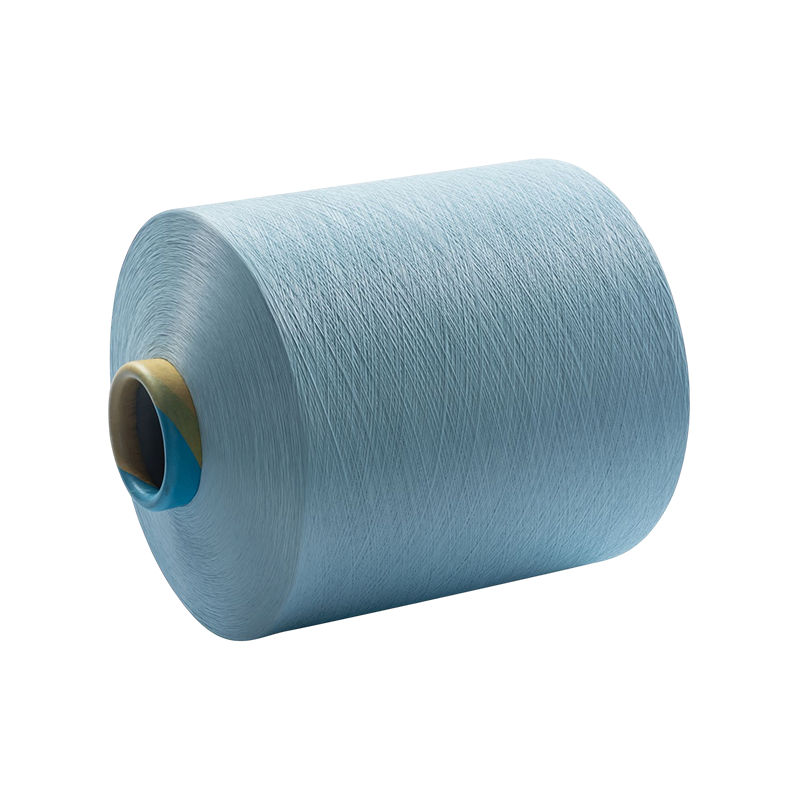 High Elastic Eco-Friendly Polyester DTY Yarn Blue Series ZB0118 350Blue-series 350D DTY with deep-blue pigment, UV resistance and laundering colour retention, suited to workwear and upholstery programmes needing stable navy-blue shades.View Product →
Uniform and corporate workwear programmes are the clearest fit. A navy or blue 350 shade absorbs the tint of mixed flake, holds grade 4 or better washing fastness, and lets a buyer lock a colour for several seasons without a dye lot re-approval on every order.
- Yarn of 150D and above, where flake quality variation has less effect on filament breaks.
- Solution-dyed colours, which remove the dye bath and its water load.
- Programmes with a multi-season colour lock, because the input stream stays stable.
- Fabrics where 85 percent or more of the weight can be covered by the recycled claim.
- Bright white and pastel shades, which require near-clear flake and tighter incoming inspection.
- Yarns below 50D, where contamination shows up as visible specks.
- Textile-to-textile recycling loops, which still depend on chemical routes at scale.
- Blends with elastane, where separation at end of life is not yet solved.
Direct Answers on Cost, Substitution and Certification
Does recycled polyester DTY cost more than virgin DTY?
Yes, but less than most buyers assume. Mechanically recycled DTY typically carries a 5 to 15 percent premium over virgin DTY of the same denier, driven by flake sorting and certification costs rather than by spinning. The gap narrows toward zero when virgin chip prices rise, because recycled flake pricing is decoupled from the paraxylene chain.
Can recycled DTY be substituted into an existing fabric construction without re-engineering?
Yes, for deniers between 75D and 300D. The texturing route is unchanged, and the knitting or weaving parameters usually stay inside existing tolerance. Two settings normally need adjustment: melt temperature, because flake intrinsic viscosity runs 0.10 to 0.20 dl/g higher than virgin chip, and draw ratio, to hold boiling water shrinkage at or below 5.0 percent.
How much recycled content does a claim require?
Under GRS 4.0, a product needs at least 20 percent recycled content to be certified, and at least 50 percent to carry the GRS logo. The Recycled Claim Standard starts at 5 percent. ISO 14021 requires any self-declared claim to be specific, substantiated and verifiable, so recycled alone is not a compliant statement on a hangtag or a specification sheet.
What lead time should a buyer plan for?
Plan 25 to 30 days from enquiry to dispatch. Five to seven days go to lab dip approval, and roughly 20 days from order confirmation to dispatch follow, which matches the delivery commitment published by Hengke Textile for standard colours. Solution-dyed lots move through that window more predictably than package-dyed lots, because the colour is fixed at the spinning stage instead of queuing behind a dye house schedule.