English
 Español


Article Directory
An elastic knit that passed its stretch panel on an air covered yarn sample will not reach the same target if the yarn is switched to a plain polyester DTY, because the two yarns generate elasticity through different mechanisms: crimp geometry built into the filament itself, against an elastane core locked under a filament sheath.
For a mill running circular knitting, warp preparation or narrow fabric lines, that structural gap surfaces in three places: the yarn purchase order, the heat setting recipe, and the final stretch test on the finished roll. This comparison sets polyester DTY and ACY yarn side by side on structure, mechanical performance, processing conditions and sourcing, using the test methods most buyers apply before releasing a bulk order.
Polyester DTY (draw textured yarn) is a false twist textured filament yarn in which bulk and crimp are engineered into the filament itself. ACY (air covered yarn) is a composite yarn in which an elastane core is wrapped by polyester or nylon filaments and mechanically locked by air jet intermingling.
How Polyester DTY and ACY Yarn Differ in Structure
Polyester DTY and ACY differ in one structural respect that drives every downstream decision: DTY is a single component textured yarn whose stretch comes from false twist crimp, while ACY is a two component composite whose stretch comes from an elastane core.
Polyester DTY: texture engineered into the filament
Polyester DTY starts as partially oriented yarn and runs through a false twist texturing line, where twist, heat and cooling set a permanent crimp into the filament. The yarn leaves the line bulky, soft and mildly elastic, with a linear density commonly between 50D and 300D and a filament count between 24 and 144. Nothing inside the yarn is elastomeric: the stretch is geometry, and that geometry flattens under sustained load.
ACY: a composite locked together by air intermingling
ACY is built the other way round. A bare elastane core, usually 20D to 40D, is fed through an air jet while polyester or nylon filaments wrap around it. Compressed air creates intermingling points that bind sheath and core, so the yarn behaves as one end on the knitting machine instead of two separate feeds. Stretch comes from the core, while the sheath controls surface character, dyeability and abrasion resistance.
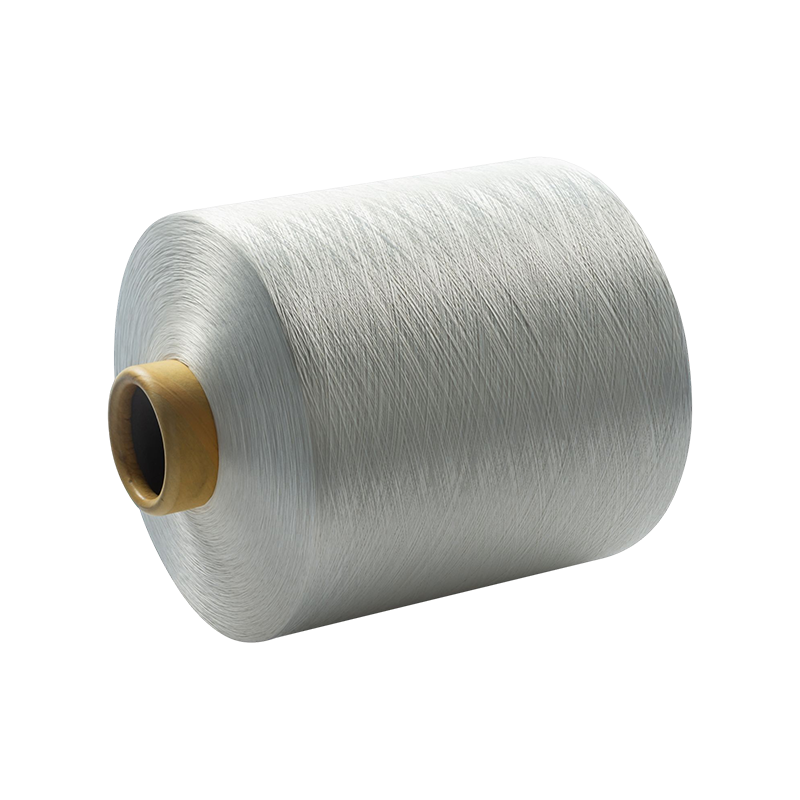 Polyester DTY Yarn Category by Hengke TextileExplore Hengke's polyester DTY range, including antibacterial, recycled, high-elastic, and custom-color yarns, with ACY listed separately for stretch applications.View Product →
Polyester DTY profile
- Single component, 100% polyester filament
- Stretch from false twist crimp, not from an elastomeric core
- Standard counts 50D to 300D, 24 to 144 filaments
- Heat setting above 180 degrees C is routine
- Broad color program across many shade families
ACY profile
- Two components: elastane core plus polyester or nylon sheath
- Stretch from the core, typically 20D to 40D elastane
- Outer filament commonly 30D to 150D
- Keep finishing dwell short below roughly 175 degrees C
- Narrower color range, shade set by sheath coverage
Polyester DTY vs ACY Yarn: Side by Side Comparison
Across the ten attributes that decide fabric behavior and landed cost, polyester DTY wins on price per kilogram and color range, while ACY wins on elastic recovery and dimensional stability in stretch garments.
| Attribute | Polyester DTY | ACY (air covered yarn) |
| Yarn structure | Single component false twist textured filament | Elastane core with a polyester or nylon sheath |
| Source of stretch | False twist crimp geometry | Elasticity of the elastane core |
| Typical linear density | 50D to 300D, 24 to 144 filaments | 20D to 40D core with 30D to 150D outer filament |
| Elongation at break, ISO 2062 | 20% to 35% for standard lots | 100% and above, set by core ratio and draw ratio |
| Recovery under repeated extension | Limited, crimp fatigues under sustained load | High, the core returns the fabric to its shape |
| Thermal ceiling in finishing | Heat setting above 180 degrees C is routine | Short dwell below roughly 175 degrees C |
| Dyeing behavior | Disperse dye at 130 degrees C, deep shades straightforward | Disperse dye compatible, elastane can yellow at high temperature |
| Color availability | Broad, organized by shade family and item number | Narrower, final shade depends on sheath coverage |
| Relative cost per kilogram | Lower, one production route | Higher, elastane plus an extra covering step |
| Common end uses | Knitwear, home textiles, upholstery trim | Seamless activewear, compression garments, elastic trims |
Stretch Envelope by Fabric Construction
Construction changes achievable stretch more than the yarn label does: a plain DTY single jersey lands at 10% to 20% stretch, a DTY plaited with 20D elastane at 40% to 80%, an ACY knit at 60% to 120%, and a spindle covered yarn knit at 80% to 150%.
Indicative stretch range by elastic knit construction
Where the target sits above 40% stretch with recovery above 90%, ACY is the correct specification. Below 20% stretch, a plain polyester DTY keeps the fabric lighter on cost and simpler to finish, because no elastane protection is needed in the heat setting range.
Stretch and recovery are separate properties and are measured separately. A yarn can extend far and still fail to return, which is why stretch recovery testing on ACY yarn always reports both the extension and the percentage of recovery after a fixed number of cycles.
Denier Ratio, Cost and Quality Control
Order ACY by denier ratio rather than by a single number, because the ratio keeps both components visible on the purchase order: a specification written as 2/70/34 carries three separate values, so the elastane count and the outer filament count are never hidden behind a trade name.
Fix the denier ratio before comparing prices
Elastane content is the largest single driver of ACY cost. Moving from a 20D core to a 40D core changes both the price per kilogram and the stretch of the finished fabric, so the ratio belongs in the first quotation rather than in a later negotiation.
Ask for the intermingling density
Request the nip count per meter and confirm it on a trial roll. Too few intermingling points and the sheath slips during knitting, exposing bare elastane at the needle; too many and the yarn stiffens, which reads as a harder hand in the finished fabric.
Test the single end to ISO 2062
Breaking force and elongation at break on a constant rate of extension tester separate a sound lot from a marginal one. Run the test on incoming cones rather than relying on the supplier certificate alone.
Test the fabric for stretch and growth
ASTM D2594 covers stretch, growth and recovery of elastic fabrics. Write the number of extension cycles and the recovery percentage into the specification, because a single cycle figure flatters every yarn on the market.
Lock the color reference to the denier code
A color approved on a 150D lot will not automatically match on a 75D lot, because filament count changes how light scatters from the yarn surface. Record both references on the same line of the order.
Zhejiang Hengke Textile Technology Co., Ltd., headquartered in Hangzhou, China, runs its own testing laboratory, states annual capacity above 300,000 tons and quotes a standard lead time of 20 days after order confirmation.
Color and Specification Matching for Repeat Orders
A repeat order needs two references rather than one: the color reference and the denier code. Mills that record only a color name end up re-approving every repeat, because shade drifts as soon as the filament count changes.
 Anti-Wrinkle Antibacterial Polyester DTY Yarn ZG0136 Grass GreenFunctional 300D draw textured ZG0136 yarn with eco-dyeing, moisture-wicking, UV stability, and antibacterial performance; reference item code with Grass Green color for repeat orders.View Product →
Zhejiang Hengke Textile Technology Co., Ltd. organizes its DTY range as product family, item number and color reference, so a repeat can be placed from a single code. The full color card groups yarns by shade family, running from beige and gray through blue, green, pink, purple and red, and each family lists the item numbers stocked against it. ACY yarn sits as a separate product category, which keeps elastane based specifications out of the DTY color list and prevents the two from being substituted by accident.
Practical Questions Buyers Ask Before Ordering
Can ACY yarn be replaced with polyester DTY without changing the fabric?
No. DTY delivers 10% to 20% stretch in a plain jersey, while an ACY knit reaches 60% to 120%, so a direct swap changes both stretch and recovery. Substitution is only realistic when the target fabric needs under 20% stretch and no recovery figure is written into the specification.
Which yarn costs less per kilogram delivered?
Polyester DTY, because it runs on a single texturing route with no elastane content. ACY carries two cost layers: the 20D to 40D elastane core and an additional air covering step. The gap narrows once the comparison moves to cost per meter of finished fabric, since ACY usually allows a lighter construction for the same stretch target.
What test methods should appear on the purchase order?
Three cover most programs: ISO 2062 for single end breaking force and elongation at break, ISO 13934-1 for fabric tensile properties, and ASTM D2594 for stretch and growth of the finished elastic fabric. Adding the recovery percentage and the number of extension cycles removes the ambiguity behind most quality claims.
Does heat setting damage ACY yarn?
It can. Elastane starts to lose tensile strength above roughly 175 degrees C, so ACY is normally finished with a shorter dwell and a lower temperature than a 100% polyester construction. Where a high temperature set is unavoidable, retained stretch must be confirmed on a trial roll before bulk production begins.