
 English
 Español


Article Directory
- 1 What Polyester DTY Is and How to Read a Spec Line
- 2 Match Denier and Filament Count to the Fabric You Are Making
- 3 Knitting Versus Weaving: Two Different Buying Briefs
- 4 Shrinkage, Tenacity, and Elongation: The Certificate Values That Predict Failure
- 5 Color Consistency, Dope Dyeing, and Lot Matching
- 6 Sampling, Lead Time, and Locking the Spec Into the Purchase Order
- 7 Questions Buyers Ask Before Specifying DTY
Two mills order the same 150D/48F polyester DTY at the same price, run it on the same circular knitting machine, and ship fabric that feels nothing alike. The difference is rarely the polymer. It is the secondary values on the lot certificate: boil-off shrinkage, tenacity, and intermingling count.
Polyester DTY is quoted by denier and color, but it is judged in the greige room on everything else. A 150D/48F lot at 3 percent shrinkage and 50 nips per meter behaves like a different yarn from a 150D/48F lot at 7 percent and 100 nips per meter, even though both invoices carry an identical description.
Buying on denier and price alone hands control of fabric performance to the supplier's default settings. What follows connects a DTY line item to the fabric it will become, application by application.
What Polyester DTY Is and How to Read a Spec Line
Polyester DTY, draw textured yarn, is a continuous filament yarn that is drawn and false-twist textured in a single integrated process, which gives it crimp, bulk, stretch, and a soft hand that flat filament yarn cannot match.
The specification line is a compact instruction set. Take 150D/48F semi-dull:
- 150D is linear density. One denier equals one gram per 9,000 meters, so 9,000 meters of this yarn weigh about 150 grams. ISO 2060 is the reference method for measuring it.
- 48F is filament count, meaning 48 continuous filaments run the full length of the package.
- 3.1 dpf is denier per filament, calculated as 150 divided by 48. Below 1.0 dpf a yarn counts as microfiber, while 2.0 to 4.0 dpf is the standard apparel band.
Denier alone does not predict fabric behavior. Two other value families do. Mechanical values such as tenacity, elongation at break, and crimp decide how the yarn survives the machine. Physical values such as shrinkage, oil pick-up, and intermingling decide how it survives finishing.
Polyester DTY is a false-twist textured continuous filament yarn, specified as denier and filament count and controlled lot by lot through shrinkage, tenacity, elongation at break, and intermingling count.
Ask for those four numbers on the certificate of analysis before comparing quotations. Two offers described as 150D/48F are not the same offer until the certificate is on the table.
Match Denier and Filament Count to the Fabric You Are Making
Start from the fabric, not the yarn: a 75D/36F sheer lining and an 840D/192F bag fabric are never interchangeable, and fabric weight, cover factor, and the hand you are selling determine denier and filament count almost automatically.
| End application | Typical denier and filament | Denier per filament | Value to control first |
| Sheer lining, chiffon, light tricot | 50D/24F to 75D/36F | 1.4 to 2.1 dpf | Boil-off shrinkage below 3 percent |
| Soft jersey, T-shirt, activewear base | 100D/96F to 150D/144F | 1.0 to 1.5 dpf | Uniform intermingling, low oil pick-up |
| Woven outerwear, suiting, workwear | 150D/48F to 300D/96F | 3.1 to 4.5 dpf | Tenacity at or above 3.5 cN/dtex |
| Home textile, curtain, upholstery | 300D/96F to 600D/192F | 3.1 to 4.0 dpf | Light fastness, abrasion resistance |
| Bag fabric, webbing, industrial cloth | 420D/96F to 840D/192F | 4.4 to 5.8 dpf | Tenacity above 6.0 cN/dtex |
The pattern holds across the table: the heavier and more durable the end product, the higher the denier band and the higher the tenacity you should write into the order.
Neutral undyed yarns cover the widest range of programs, because they can be piece dyed to any shade after knitting or weaving. Hengke Textile Technology Co., Ltd. lists a rice white polyester DTY under two article numbers, ZY0050 and ZY0238FM, which is the kind of base yarn a dyehouse wants when several fabric qualities must share one white point.
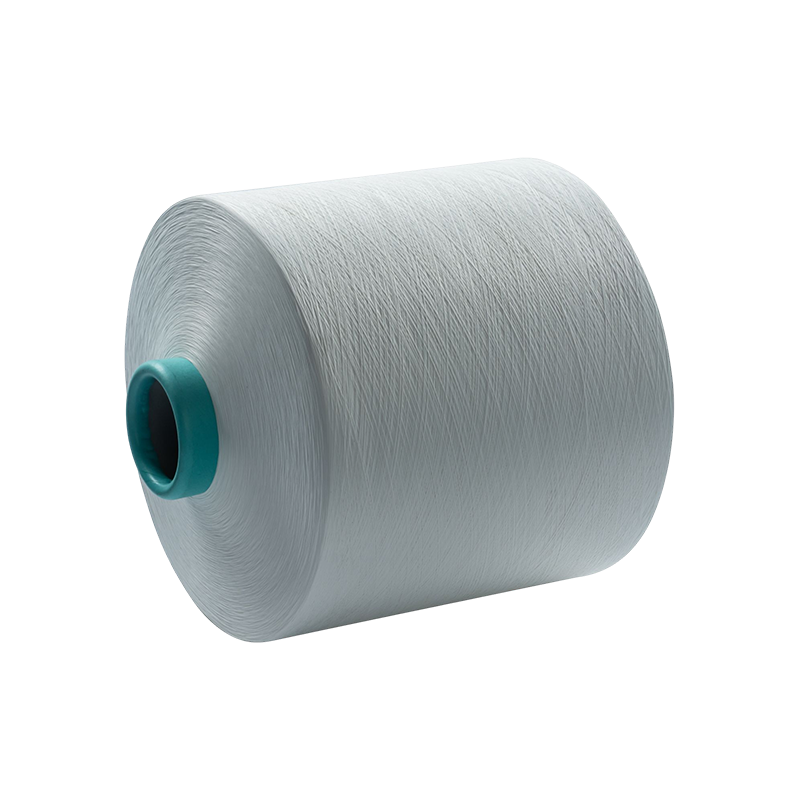 Antibacterial Anti-Odor Polyester DTY Yarn White and GreyNeutral undyed antibacterial polyester DTY base yarn for knitting or weaving, available in white and grey under ZY0050 and ZY0238FM.View Product →
Knitting Versus Weaving: Two Different Buying Briefs
Circular knitting and weaving put different demands on the same DTY package: knitting rewards uniformity, and weaving rewards strength.
- Intermingling of 40 to 80 nips per meter keeps the yarn flat enough for tight needle gauges while still holding the filaments together.
- Shrinkage variation between packages should stay inside 0.5 percentage points, because a wider spread shows up as barré lines.
- Finer filaments, from 1.0 to 1.5 dpf, improve drape in single jersey and interlock.
- Higher tenacity matters more, since warp yarns run through healds and reeds at speed and 3.5 cN/dtex upward reduces breakage.
- Intermingling of 80 to 120 nips per meter cuts filamentation and loom stops.
- Lower shrinkage, from 2 to 4 percent, keeps warp tension stable through sizing and desizing.
If you run both knitting and weaving, do not buy one yarn for both. Splitting the order into a low-shrinkage, high-intermingling cone for warp and a softer, finer-filament cone for circular knitting costs a few cents per kilogram and removes a far more expensive failure mode: loom stoppage and second-quality fabric.
Shrinkage, Tenacity, and Elongation: The Certificate Values That Predict Failure
Three values on the certificate of analysis predict more field failures than any others: boil-off shrinkage, tenacity, and elongation at break. Test all three under ISO 139 conditions, at 20 degrees Celsius and 65 percent relative humidity, because polyester takes up moisture slowly and reads differently in a dry laboratory.
Shrinkage drives fabric geometry. A yarn specified at 2 to 3 percent in boiling water is not a substitute for one at 6 percent, because the two finish to different widths and different stitch densities. Measure five packages per lot rather than one, and record the spread as well as the average.
Tenacity matters wherever the yarn meets metal. A lot at 3.2 cN/dtex on the low edge of the standard window breaks more often than one at 4.0 cN/dtex, and the price gap between those two lots is usually smaller than the cost of a single loom stoppage. A published breakdown of the key tests for DTY covers the same test set and confirms that tensile and shrinkage results travel together.
Test shrinkage on every incoming lot, tenacity on the first lot of each article number, and elongation whenever the spinning supplier changes. Those three checks cover the failures that reach the customer.
Color Consistency, Dope Dyeing, and Lot Matching
For colored programs the real decision is between package dyeing after fabric formation and dope-dyed yarn, where pigment is added to the polymer melt before spinning, and dope dyeing removes the dye bath entirely.
That process difference shows up in the numbers. Dark dope-dyed shades typically hold light fastness of grade 4 to 5 on the ISO 105-B02 scale, against grade 3 to 4 for many package-dyed lots, and they avoid the shade drift that appears when a dyehouse runs the same recipe in a different machine.
Lot matching is where colored programs succeed or fail. A workable production tolerance is a color difference of Delta E 1.0 or less measured under D65 lighting, with a retained sample kept from every lot. Anything looser becomes a claim the moment panels from two lots sit side by side in a showroom.
Hengke Textile Technology Co., Ltd. organizes part of its DTY range by color as well as by article number. Grass Green 084, listed under article ZG0136, sits alongside a full color card grouped into beige, blue, brown-curry, gray, green, orange-yellow, pink, purple, and red families, and each family holds enough entries to match a shade across several fabric qualities.
-1.png) Anti-Wrinkle Antibacterial Polyester DTY Yarn Grass Green 084Green Series DTY in Grass Green 084 for matching green shades across fabrics; antibacterial and wrinkle-resistant for apparel, home textiles, and technical use.View Product →
Anti-Wrinkle Antibacterial Polyester DTY Yarn Grass Green 084Green Series DTY in Grass Green 084 for matching green shades across fabrics; antibacterial and wrinkle-resistant for apparel, home textiles, and technical use.View Product →
Approve a 10 cm by 10 cm hand panel in the final shade and construction rather than a yarn bunch. Color reads differently on a cone and in fabric, and the panel is what the buyer signs against at shipment.
Sampling, Lead Time, and Locking the Spec Into the Purchase Order
A DTY program moves from sample cone to loaded container in five steps, and every step has a number attached to it.
- Request 2 to 3 kg sample cones per color and specification, each with a certificate of analysis.
- Knit or weave 20 to 30 meters of trial fabric on production equipment rather than on a lab machine.
- Finish the trial through your normal route and measure shrinkage, hand, and shade against the approved panel.
- Write the purchase order with the full specification: denier and filament count, shrinkage range, minimum tenacity, intermingling count, color tolerance, and package weight.
- Confirm the delivery date against your cutting plan, and book the production slot when the sample is approved rather than when the order is signed.
Suppliers state capacity and lead time differently, so ask for both in writing. Hengke Textile Technology Co., Ltd. reports annual capacity above 300,000 tons and a standard lead time within 20 days of order confirmation, and a supplier with that capacity can still queue during a peak season.
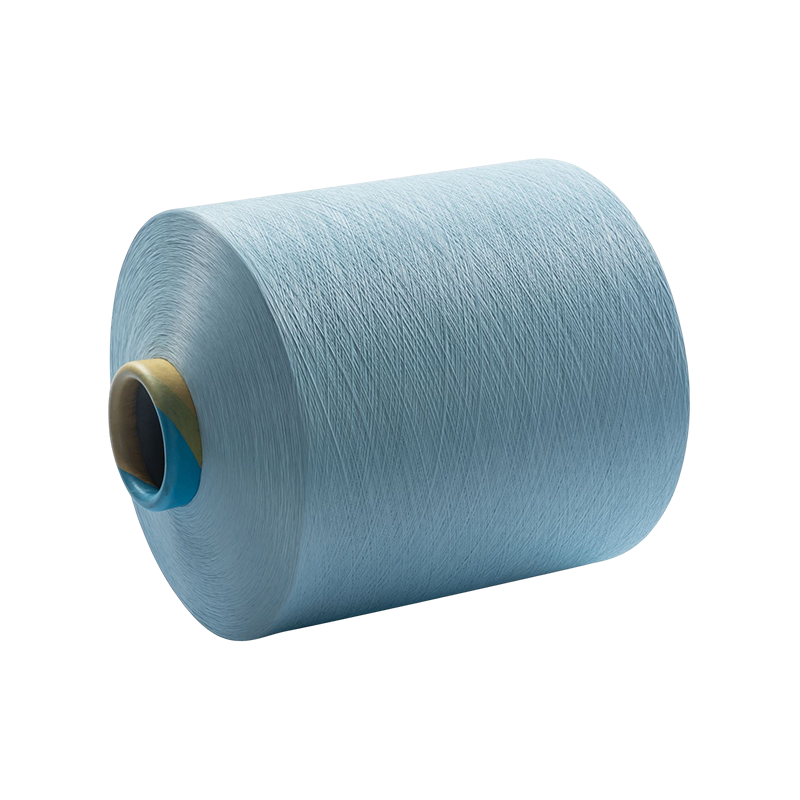 High Elastic Eco-Friendly Polyester DTY Yarn Blue Series ZB0118Medium-heavy 350D blue DTY for outdoor furniture, automotive interiors, and technical workwear; elastic, durable, with GRS and OEKO-TEX options.View Product →
Questions Buyers Ask Before Specifying DTY
What denier should a first-time buyer start with?
150D/48F semi-dull is the safest first specification. It covers woven outerwear, workwear, and medium-weight knits, runs on most machinery, and sits near the middle of the standard tenacity window at 3.5 cN/dtex. Order 3 kg per color so the trial run has enough material for a full finishing pass.
Does a higher filament count always mean a softer fabric?
Up to a point. At a fixed 150 denier, moving from 48 to 144 filaments drops denier per filament from 3.1 to 1.04, which raises bending softness and cover. Below 1.0 dpf the yarn enters microfiber territory, where hand improves further but each filament carries less load, so yarn tenacity falls and pilling risk rises in loose knits.
How do I verify shrinkage before bulk production?
Run a boil-off test on five packages per lot: 30 minutes in boiling water, conditioned to ISO 139 at 20 degrees Celsius and 65 percent relative humidity, measured before and after. Accept the lot when the average falls inside your stated range and the spread across packages stays within 0.5 percentage points, since greige width variation follows that spread directly.
Dope-dyed yarn typically carries a premium of 5 to 15 percent per kilogram over raw white, and it pays back when the shade is dark or the volume is large enough to delete a process step. On a 5,000 kg fabric order, removing package dyeing removes an entire wet process, its water and energy load, and the risk of a mismatched dye lot.
One yarn per application, one certificate per lot, and one approved panel per shade. Those three documents settle more disputes than any price negotiation.
-2.png "High-performance environmentally friendly polyester DTY yarn Brown Series ZN0085 FM")
-3.png "Full-color custom polyester DTY yarn Silver Series ZE0006-ZE0668 121")
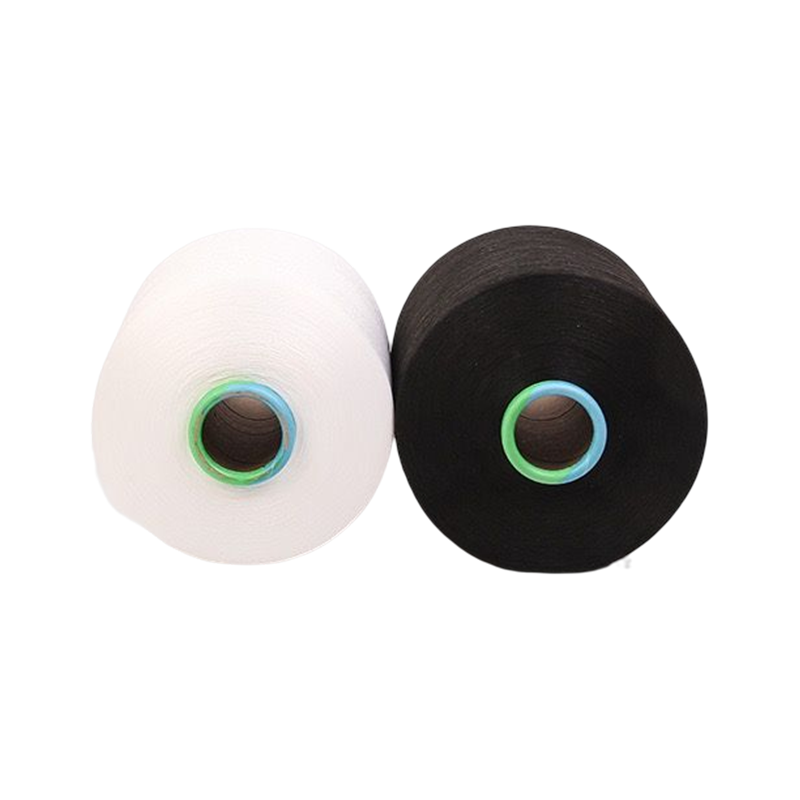
-2.png "Antibacterial and anti-odorant polyester DTY yarn White/Grey ZY0050-ZY0238FM")
-2.png "Lightweight soft polyester DTY yarn Light Pink/Red/White/Purple/Yellow ZR0161-ZR0313 758")
-3.png "Wash-resistant and wear-resistant polyester DTY yarn Yellow/Grey/White ZY0076-ZY0334 178")
-2.png "High elastic environmentally friendly polyester DTY yarn Blue Series ZB0118 350")
-2.png "Anti-wrinkle and antibacterial polyester DTY yarn Green Series ZG0136 Grass Green 084")
