English
 Español


Article Directory
- 1 Consistent quality is a measured band, not a perfect sample
- 2 Five process points where a bulk run drifts
- 3 From chip to wound package: the five-stage control chain
- 4 Colour consistency is a separate discipline from physical consistency
- 5 Stretch fabrics add a second control loop: the elastane core
- 6 Ordering 50 tonnes at a time: the numbers that have to hold
- 7 Questions buyers ask before scaling a yarn order
Order 200 tonnes of 150D/48F polyester draw textured yarn and the purchase order will be written in kilograms, deniers and delivery dates. The fabric that comes off the knitting machine is judged in shade bands, needle lines, barré and break-out rates instead. The distance between those two sets of numbers is exactly where a yarn manufacturer either supports consistent quality or quietly erodes it.
Consistent quality is a measured band, not a perfect sample
A yarn mill supports consistent quality when the coefficient of variation (CV) of linear density, breaking tenacity, elongation, shrinkage and colour stays inside a declared band from the first package of a lot to the last, verified through methods such as ISO 2060 for linear density and ISO 2062 for single-end tensile properties.
A reference sample proves one point in time, drawn from one spindle position, on one day. It cannot show what happens on package 480 of 600, after eight hours of continuous texturing, when the heater zone has drifted three degrees and the spin finish pump has run two percent rich. Buyers who select a supplier on the sample card alone are selecting a photograph, not a production line.
This is why benchmark systems such as USTER Statistics, published by Uster Technologies and used as a global reference since the 1950s, compare whole-lot distributions rather than single readings. The question is never "is this yarn good". The question is "how far does this yarn move between the first and the last package".
When that band breaks, the failure does not appear as a rejected cone. It appears downstream as barré stripes in a circular-knit panel, needle lines in a warp beam, or a shade jump in a garment that was cut from two different cartons of the same colour code.
Five process points where a bulk run drifts
Bulk yarn quality moves at five points: PET chip condition, spin finish pick-up, draw-texturing heat and D/Y ratio, winding tension and package build, and colour handling. Each one has a measurable control, and each one is cheaper to hold than to correct after shipment.
| Process variable | What drifts at scale | Control that holds the band |
| PET chip intrinsic viscosity and moisture | Intrinsic viscosity drifting outside 0.62 to 0.68 dL/g, or moisture above 50 ppm, shifts breaking strength across an entire lot | Incoming chip IV tested per silo, with drying held below 50 ppm before extrusion |
| Spin finish pick-up | Pick-up outside 0.30 to 0.60 percent on weight of fibre creates static, fly and uneven friction in downstream texturing | Finish metered in line and verified gravimetrically every shift |
| Texturing heater temperature and D/Y ratio | A drift of a few degrees changes crimp, bulk and elongation without changing the denier on the label | Recipes locked per denier, heater zones logged per spindle position |
| Winding tension and package build | Soft or bulged packages slough, trap broken filaments and stop high-speed knitting machines | Tension-controlled winding with density and taper checked every doff |
| Colour handling | Shade drifts between dye lots and between packages inside the same lot | Colour measured as Delta E under D65 illumination and held at 1.0 or below |
Most yarn drift is cumulative rather than sudden. A finish pump running two percent rich for six hours does not break a single filament; it changes friction enough that the same yarn knits at a different tension the next morning. That is why hourly and per-doff checks beat end-of-lot inspection.
 Brown Series ZN0085 FM Polyester DTY YarnBrown 200D polyester DTY with anti-wrinkle, moisture-wicking properties and tight color control for apparel, home, and technical fabrics.View Product →
From chip to wound package: the five-stage control chain
Control runs in a fixed sequence: chip conditioning, melt spinning, draw texturing, interlacing and winding, then release testing. Skip the measurement at one stage and the defect surfaces two stages later as break-out, bulk variation or shade drift.
Chip conditioning
Textile-grade PET chip is dried until residual moisture sits below 50 ppm, because residual water hydrolyses the polymer during melting and cuts tenacity in a way no downstream process can restore.
Melt spinning and quenching
Spinning temperature, pack pressure and quench air velocity set the as-spun filament structure. Spin finish is applied at 0.30 to 0.60 percent on weight of fibre so the yarn survives drawing and later knitting without generating static.
Draw texturing
Draw ratio, D/Y ratio and heater temperature decide crimp, bulk and elongation. Heater settings typically sit between 180 and 220 degrees C depending on denier and machine, and they are locked per recipe rather than adjusted operator by operator.
Interlacing and winding
Interlace level, winding tension, package density and taper determine whether the cone unwinds cleanly at 1,000 metres per minute on a knitting machine. Package build is inspected every doff, not once per shift.
Release testing
Each lot is tested for linear density to ISO 2060, tensile properties to ISO 2062, boiling water shrinkage and colour difference before it is released for packing. A lot that fails any band is held, not blended into the next one.
CV bands commonly written into a 150D/48F DTY supply specification (illustrative control targets, not a guarantee for every machine)
The pattern matters more than any single bar. Linear density usually holds tighter than any other property because it is measured continuously on line, while elongation and interlace depend on mechanical settings that wear over a production week.
Colour consistency is a separate discipline from physical consistency
Colour is held to Delta E 1.0 or tighter under D65 illumination, and it is governed by pigment metering and dye-lot discipline rather than by spinning physics. A mill can hold tenacity within two percent and still ship a shade that reads differently under store lighting.
Two routes exist, and they carry different risks. Piece dyeing puts the shade decision at the fabric stage, where a whole roll can be lost to a bad bath. Dyed-through filament yarn, where pigment is added before extrusion, removes the dye bath and with it the lot-to-lot shade jump; the trade-off is that the shade must be committed at the spinning stage, in a fixed quantity, months ahead of the garment order.
That is why a working colour index matters as much as a lab. A structured colour card library organised by shade family lets a buyer match a target swatch to a production code before sampling, instead of sending a physical swatch back and forth for three weeks. In practice the colour families that carry the largest repeat volumes are the neutrals, because a shade mismatch on white, beige or grey shows up in the finished garment far more clearly than a mismatch inside a seasonal print.
Traceability completes the loop. If a shade complaint arrives with a package code, the mill can trace back to the chip silo, the spinning position, the texturing machine and the test record for that lot. Without a lot code printed on the carton, that investigation ends at the warehouse door.
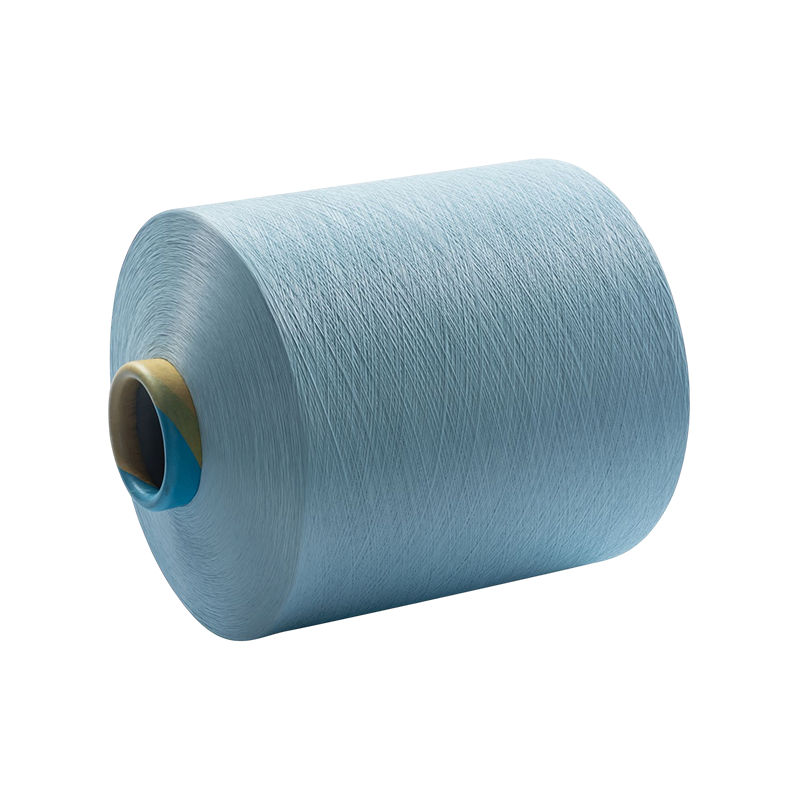 Blue Series ZB0118 350 Polyester DTY YarnBlue 350D polyester DTY with 72F, dual-heat texturing, and high-pressure dyeing for sportswear, upholstery, and industrial uses.View Product →
Stretch fabrics add a second control loop: the elastane core
Air-covered yarn quality depends on core draft, wrap density and relaxation, and the acceptance test is stretch recovery after repeated extension rather than a single elongation reading. A construction with a 20 to 70 denier elastane core wrapped by textured polyester filament behaves differently from a plain DTY of the same linear density.
The core is the source of most variation. If draft ratio moves between spools, recovery moves with it, and the fabric loses shape after the first wash rather than after the thirtieth. The sheath matters too: interlace level and wrap density decide whether the elastane stays covered during knitting and whether loops appear at the needle.
- Core draft ratio held inside a narrow band so recovery does not drift between spools of one order
- Wrap density and interlace level measured on the package, not judged from a hand sample
- Relaxation time after covering controlled, because yarn wound too hot keeps shrinking inside the finished fabric
- Recovery tested after repeated extension cycles instead of one elongation figure
For seamless activewear and medical compression stockings, the acceptance criterion is usually recovery after cycling rather than the stretch percentage on the label. A yarn that stretches to 180 percent but returns to 118 percent is not a stretch yarn; it is a yarn that stretches once.
 Air Covered Spandex Polyester Yarn White/BlackAir-covered spandex core with polyester DTY cover in white/black, offering elastic recovery, torque-free performance, and smooth coverage for activewear and stretch denim.View Product →
Ordering 50 tonnes at a time: the numbers that have to hold
Large orders stand or fall on three numbers: annual capacity, committed lead time, and the sample-to-bulk agreement. Zhejiang Hengke Textile Technology Co., Ltd. (Hengke Textile), based in Hangzhou, reports an annual capacity above 300,000 tonnes and a typical delivery window of 20 days after order confirmation, backed by an in-house testing laboratory and warehousing capacity for bulk storage.
Capacity only helps if the shades and deniers you need are already running. A 300,000-tonne line that has to be re-scheduled for a single 3-tonne colour is slower than a smaller mill running that colour continuously. When a buyer places a 50-tonne order, the practical question is how many production batches the order will be split into, because shade drift happens at batch boundaries, not inside a batch.
A supply agreement that supports consistency in practice carries five clauses, and they cost nothing to write before the order:
- Denier and filament count stated as nominal plus tolerance, with the test method named (ISO 2060 for linear density, ISO 2062 for tensile).
- CV bands for linear density, tenacity, elongation and shrinkage, quoted per lot rather than per sample.
- Colour tolerance expressed as Delta E under a named illuminant, with the limit stated numerically.
- A sampling plan naming how many packages per container will be retested by the buyer, and under what conditioning.
- A batch-continuity clause: if one order is split across batches, the mill supplies the batch split and keeps retained samples of each.
Consistency is not a quality department output. It is a purchasing decision that has already been made the moment the tolerance band is written into the order confirmation, because the mill will hold whatever band the buyer commits to and nothing tighter.
Practical procurement note: the fastest way to verify a supplier is to request release-test data from a shipped lot, not from a laboratory sample. Ask for the raw values per package and the lot average. A supplier holding a real band can produce that record within a day; a supplier holding only a sample card cannot produce it at all.
Questions buyers ask before scaling a yarn order
What CV level should a bulk DTY order specify?
Start from your own process capability and write the band backwards. For most circular knitting programmes, a workable commercial starting point is linear density CV at or below 2.0 percent, breaking tenacity CV at or below 6.0 percent and colour Delta E at or below 1.0 under D65. The exact figures should be quoted per denier from the mill's own release-test records, because a 75D/72F yarn and a 300D/96F yarn do not hold the same CV. A supplier who will not show lot-level data for the specific denier you are buying has not tested it at that denier.
How many packages should be tested to prove consistency?
Sample at the lot boundary, not in the middle. A practical plan tests six to ten packages per container, drawn from the start, middle and end of the production run, conditioned to ISO 139 (20 +/- 2 degrees C, 65 +/- 4 percent relative humidity) for at least four hours before testing to ISO 2060 and ISO 2062. Values from the first and last package of the same lot are the most informative pair: if they agree within the specified CV band, the run was stable.
Can a 20-day delivery window hold for a 100-tonne order?
It can when the shades and deniers are already in routine production, because the constraint is scheduling rather than machine speed. An operation running above 300,000 tonnes of annual filament capacity and holding stock in its own warehouse can ship a repeat order in roughly 20 days after confirmation. The window stretches when a colour has to be matched from scratch or when one order must be split across more than three production batches, since every new batch needs its own release test before packing.
Is dyed-through yarn or piece dyeing more consistent for large programmes?
Dyed-through filament yarn is more consistent at volume, because pigment enters before extrusion and the shade is fixed at the polymer stage rather than in a dye bath. The trade-off is commitment: the colour must be chosen early and bought in defined quantities, typically by lot, and it is not economical to re-dye a shade you dislike. Piece dyeing allows later changes but introduces a per-bath variable, and a bath that drifts by Delta E 1.5 will not be detected until the roll reaches inspection.
Whichever route you choose, fix the sampling plan, the illuminant and the Delta E limit in the purchase order. Those three lines decide more of the final fabric yield than the price per kilogram does.
For buyers who want to check colour availability before opening a technical discussion, the shade families in the quality control checkpoints for polyester DTY review the test sequence that sits behind every lot release.