English
 Español


Article Directory
- 1 What a Sportswear DTY Specification Has to Cover
- 2 Denier and Filament Count Decide the Fabric Before Knitting Starts
- 3 Tenacity, Elongation and Cyclic Fatigue
- 4 Crimp, Bulk and Boiling Water Shrinkage
- 5 Moisture Management Comes From the Filament, Not the Polymer
- 6 Colour Consistency and Colourfastness for Sportswear
- 7 The Pre-Bulk Checklist Before a DTY Order Is Confirmed
- 8 Questions Buyers Ask Before Specifying Sportswear DTY
A 150D/144F polyester DTY lot can pass its tenacity test at 3.6 cN/dtex and still be rejected at the circular knitting machine, because the property that decides whether it runs cleanly is intermingling, not strength. Below roughly 60 nips per meter, a 28-gauge machine pulls filament loops tight, breaks needles, and leaves barre marks that only surface after dyeing.
Sportswear is the most demanding apparel outlet for draw textured yarn (DTY). The fabric is thin, worn directly against skin, stretched thousands of times in use, washed at 40 C or hotter, and frequently dyed in saturated shades that expose every inconsistency in the yarn. Each of those conditions maps to a measurable yarn property with a published test standard behind it.
This guide sets out the performance requirements that matter to textile manufacturers buying polyester DTY for sportswear, the numerical windows that define an acceptable lot, and the checks worth running before a bulk order is confirmed.
What a Sportswear DTY Specification Has to Cover
Polyester DTY yarn for sportswear must satisfy four requirements at the same time: linear density inside the ISO 2060 tolerance, tenacity between 3.2 and 4.2 cN/dtex, boiling water shrinkage between 3% and 8%, and colour fastness of grade 4 or better after laundering to ISO 105-C06.
The word simultaneously is the part that manufacturers underestimate. Drawing and false-twist texturing happen in a single continuous pass on the same machine, so an adjustment made to raise tenacity also lowers elongation and shifts shrinkage. A supplier who changes texturing tension to fix one crimp complaint moves the finished fabric weight of every downstream order.
Draw textured yarn (DTY) is a continuous-filament polyester yarn produced by drawing and false-twist texturing pre-oriented yarn (POY) in one integrated process. The drawing stage sets tenacity and elongation; the texturing stage sets crimp, bulk and stretch. Both stages act on the same filament at the same moment, which is why no single property can be optimised in isolation.
That reality is why a DTY purchase specification has to state a target window for every property and accept that the mill must land inside all of them at once. Buying on tenacity alone, the most common shortcut in yarn sourcing, leaves shrinkage, intermingling and oil content unmanaged, and those three properties generate the majority of knitting-room complaints.
Denier and Filament Count Decide the Fabric Before Knitting Starts
Five linear densities cover the overwhelming majority of sportswear DTY: 50D/72F, 75D/72F, 100D/96F, 150D/144F and 300D/288F, and each one maps to a narrow band of finished fabric weight.
| Denier / filament | Denier per filament | Typical fabric weight | Typical sportswear use |
| 50D/72F | 0.69 | 90 to 120 g/m2 | Ultralight singlets, mesh inserts, liners |
| 75D/72F | 1.04 | 110 to 140 g/m2 | Base layers, jersey training tops |
| 100D/96F | 1.04 | 140 to 170 g/m2 | Training tops, light leggings |
| 150D/144F | 1.04 | 170 to 220 g/m2 | Compression tights, shorts, panels |
| 300D/288F | 1.04 | 240 to 320 g/m2 | Outer shells, reinforcement zones |
Denier per filament (dpf) decides how the finished fabric feels in the hand. Dividing denier by filament count returns 1.04 dpf for four of the five counts above, which is precisely why those counts dominate sportswear: the filaments are fine enough to bend easily against the skin without being so fine that they collapse under tension.
A 150D/144F yarn delivered as 150D/136F will knit without a single machine stop, but dpf rises to 1.10 and fabric cover, lustre and thermal hand all shift. That difference is visible in a side-by-side panel under D65 lighting, and it is the reason filament count belongs in the specification rather than in a footnote.
Denier tolerance carries a direct fabric cost. A 2% deviation on a 150D yarn moves finished fabric weight by roughly 3% to 4%, which is enough to fail a 5% weight tolerance on a 160 g/m2 single jersey.
Tenacity, Elongation and Cyclic Fatigue
Polyester DTY for sportswear is specified at 3.2 to 4.2 cN/dtex tenacity with 18% to 30% elongation at break, measured to ISO 2062 on samples conditioned to ISO 139 at 20 C and 65% relative humidity.
| Property | Test standard | Sportswear window | What a miss looks like |
| Linear density | ISO 2060 | Within 2.0% of nominal denier | Fabric weight drift, machine gauge mismatch |
| Tenacity | ISO 2062 | 3.2 to 4.2 cN/dtex | Needle lines, seam pull-out |
| Elongation at break | ISO 2062 | 18% to 30% | Brittle yarn, loop breakage at high speed |
| Crimp contraction | Supplier method | 25% to 45% | Flat hand, low bulk, poor recovery |
| Boiling water shrinkage | ISO 2505 | 3% to 8% | Stitch distortion, dimensional drift |
| Intermingling | Nip count per meter | 60 to 120 nips/m | Filament loops, needle damage, barre |
| Finish oil content | Solvent extraction | 0.3% to 0.8% | Static, filament spread, dye spots |
Tenacity without elongation is a trap. A yarn reading 4.2 cN/dtex with 14% elongation breaks at the needle during high-speed knitting and fatigues earlier under repeated extension than a 3.5 cN/dtex yarn with 24% elongation. The pairing matters more than either figure read alone.
Oil content is the test most often skipped. A finish level below 0.3% raises static and lets filaments spread at the needles; above 0.8% it risks staining in the dye bath. Most DTY mills target 0.4% to 0.6%. A full breakdown of the standard DTY quality tests covers oil content alongside crimp stability and intermingling.
Cyclic fatigue separates sportswear from general apparel. A compression tight is extended by 20% to 30% each time it is worn, and the recovery target is at least 90% within 60 seconds of release. Yarn at 3.2 to 4.2 cN/dtex with 18% to 30% elongation and a crimp contraction of 25% to 45% holds that recovery. A stiffer, higher-tenacity yarn with low crimp does not.
Crimp, Bulk and Boiling Water Shrinkage
Heat-set polyester DTY for sportswear is normally held at 3% to 8% boiling water shrinkage; below 3% the fabric knits flat and thin, and above 10% the loops close during dyeing and finished weight drifts outside the approved range.
Low shrinkage, 2% to 4%
- Stable finished dimensions after tumble drying
- Repeatable fabric weight across dye lots
- Crisper, flatter hand on thin jerseys
- Needs more aggressive heat setting and higher texturing tension
- Bulk and cover drop at the same denier
Higher shrinkage, 8% to 12%
- Fuller hand and higher bulk at the same denier
- Softer, warmer surface for base layers
- Loop distortion risk during dyeing
- Spirality and needle line in single jersey
- Weight drift that breaks a 5% gsm tolerance
The practical rule is to match shrinkage to the garment rather than to a preferred yarn feel. A single jersey training top at 140 g/m2 tolerates 4% to 6% shrinkage. A compression legging knitted on a 32-gauge machine needs the lower end of that range, because stitch distortion under permanent tension is far less forgiving than distortion in a loose knit.
Moisture Management Comes From the Filament, Not the Polymer
Polyester absorbs roughly 0.4% moisture at 20 C and 65% relative humidity, so wicking in sportswear depends on filament cross-section and fabric construction rather than on the polymer itself.
Capillary wicking height after 30 minutes by filament cross-section
Indicative commercial ranges for polyester filament yarn, expressed in millimetres of rise.
A round cross-section gives the lowest capillary rise, roughly 40 to 60 mm in 30 minutes. Moving to a trilobal or cross-shaped filament adds the channels that carry liquid away from the skin and lifts the same measurement to 100 mm and above. That is a yarn selection decision taken before the order is placed, not a finishing decision taken afterwards.
Air permeability is the other half of comfort. Summer knit sportswear normally targets 150 to 400 mm/s to ISO 9237; below that band the garment feels clammy during exercise no matter how well the yarn wicks.
Lustre belongs in the same conversation. Bright yarns reflect more visible light and read as cooler and more technical, while semi-dull yarns scatter light and mask stitch irregularity. Reflective, low-absorbance tones such as a silver grey are frequently chosen for hot-weather training ranges for the same reason.
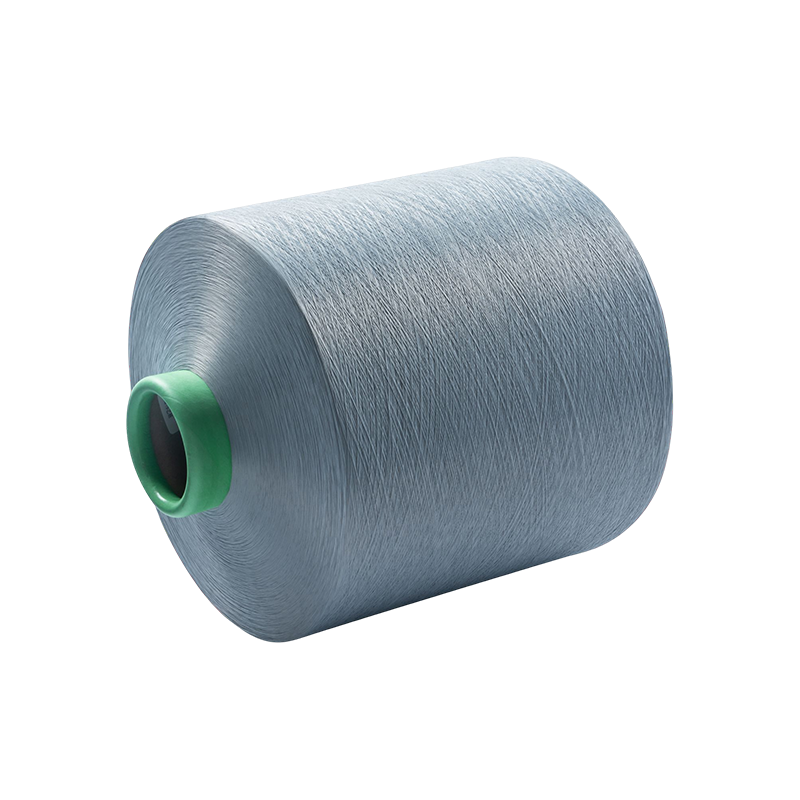 Full-Color Silver Series Polyester DTY Yarn ZE0006-ZE0668 121Semi-dull silver-luster draw textured polyester yarn with full-color customization for technical sportswear, upholstery, automotive interiors, and knitted accessories.View Product →
Colour Consistency and Colourfastness for Sportswear
Sportswear DTY should be specified at grade 4 or better for colour fastness to laundering to ISO 105-C06 and grade 4 or better for perspiration to ISO 105-E04, with saturated shades such as royal blue and hot pink the hardest to hold.
Shade approval is normally carried out at a colour difference of 1.0 or less against an approved master under D65 lighting, tightened to 0.8 or less for pale tones. The tighter figure exists because the human eye resolves small shifts on light grounds far more readily than on dark ones.
Dyeing consistency starts at the yarn. Two packages from the same lot that differ in oil content will dye at different rates, and the difference reappears as weft bar or spiral shading in the finished garment. That is why a supplier colour card is a working document rather than a marketing sheet. Hengke Textile Technology Co., Ltd. maintains a colour card index of ten pages covering beige, blue, brown-curry, grey, green, orange-yellow, pink, purple and red, which is the practical starting point for matching a sportswear shade.
Deep saturated blues are the classic problem shade. A royal or navy blue at 150D/144F has to hold its depth through five home launderings at 40 C without greying or bleeding into a white cuff.
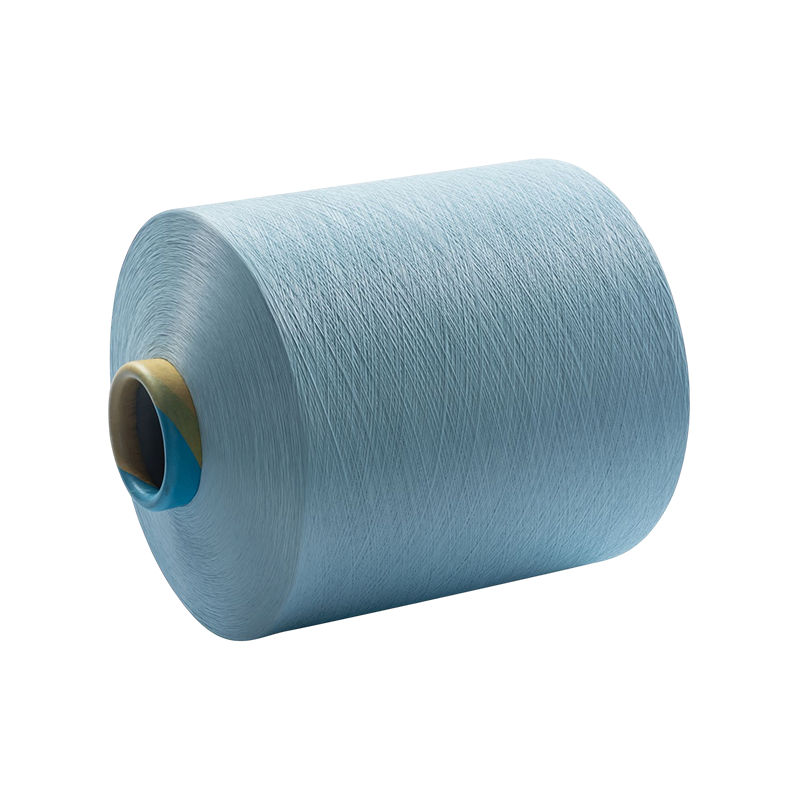 Environmentally Friendly Blue Series Polyester DTY Yarn ZB0118 350OEKO-TEX certified deep-blue pigment DTY yarn with high elasticity for technical workwear, outdoor furniture, automotive interiors, and sportswear.View Product →
The Pre-Bulk Checklist Before a DTY Order Is Confirmed
Five checks decide whether a sportswear DTY lot is safe to bulk: bobbin-to-bobbin denier variation, intermingling count, boiled and dyed shrinkage, oil content, and shade against the approved standard.
- Measure denier and filament count across at least twenty bobbins, not from a single package. Variation across the lot matters more than the average, because uneven packages knit into uneven fabric.
- Count intermingling nips per meter on at least five packages. Below 60 nips/m on a 28-gauge machine is a rejection, and 80 to 120 nips/m is the comfortable working band for fine-gauge knitting.
- Test boiling water shrinkage to ISO 2505 on the delivered lot, then knit a 30 cm tube, dye it, and measure again. The second number is the one that predicts finished garment dimensions.
- Check finish oil content by solvent extraction. Hold the lot between 0.3% and 0.8%, with 0.4% to 0.6% as the target for circular knitting.
- Assess shade under D65 lighting against the approved standard and record the measured colour difference rather than a verbal judgement. Keep the swatch for the next order.
Shade verification is the check most often compressed under schedule pressure, and it is the most expensive one to skip. Pale tones leave the least room: a colour difference of 0.6 is already visible in a folded panel, while the same shift on charcoal disappears entirely.
 Lightweight Soft Polyester DTY Yarn ZR0161-ZR0313 758 for SportswearLightweight cotton-like DTY yarn in 75D/72F and 150D/144F counts with moisture management for sportswear, innerwear, swimwear, and hosiery.View Product →
Questions Buyers Ask Before Specifying Sportswear DTY
Which polyester DTY denier suits sportswear best?
Two counts carry most of the volume: 75D/72F for jerseys and base layers between 110 and 140 g/m2, and 150D/144F for leggings and compression styles between 170 and 220 g/m2. Both sit at 1.04 denier per filament, the fineness that produces the soft hand sportswear requires.
What tenacity should polyester DTY have for sportswear?
Specify 3.2 to 4.2 cN/dtex to ISO 2062 with 18% to 30% elongation at break. Below 3.0 cN/dtex the needle-line and seam pull-out risk in thin single jersey rises sharply, while high-tenacity grades above 4.5 cN/dtex are normally reserved for industrial and webbing applications rather than garments.
How much boiling water shrinkage is acceptable?
Between 3% and 8%, measured to ISO 2505. Below 3% the knit feels flat and light; above 10% the loops contract during dyeing and finished weight moves outside a 5% tolerance, which is enough to fail an approved gsm specification.
Does polyester DTY wick moisture on its own?
No. Polyester takes up only about 0.4% moisture at 65% relative humidity, so wicking comes from capillary channels created by filament cross-section and knit structure. A round cross-section delivers roughly 40 to 60 mm of capillary rise in 30 minutes, while trilobal or cross-shaped filaments reach 100 mm and above under the same conditions.