
 English
 Español


Article Directory
- 1 Polyester Draw Textured Yarn Properties: What Texturing Does to Fiber
- 2 Polyester DTY Yarn Elasticity: Crimp Mechanics and Recovery Performance
- 3 Polyester Draw Textured Yarn Uniformity: Consistency Across the Package
- 4 Polyester Draw Textured Yarn for Knitting: Machine Compatibility and Fabric Outcomes
- 5 Polyester Draw Textured Yarn Dyeability: Crimp Structure and Dye Penetration
- 6 Polyester DTY Yarn vs FDY Yarn: Selecting the Right Construction
- 7 Specifying DTY: A Practical Checklist for Buyers
Among all engineered yarn constructions, polyester draw textured yarn occupies a unique position: it combines the molecular strength of fully drawn polyester with a deliberately introduced crimp structure that delivers stretch, bulk, and surface softness in a single continuous filament. For knitwear, activewear, and home textile producers, DTY is not a substitute for other yarns — it is the specification of choice where hand-feel and recovery performance are primary criteria.
Polyester Draw Textured Yarn Properties: What Texturing Does to Fiber
Polyester draw textured yarn properties are defined by the false-twist texturing process applied to partially oriented yarn (POY). In this process, POY passes through a twist zone — typically a friction disc system — while simultaneously being drawn under heat (170–230°C). The yarn is twisted, heat-set in the twisted state, then untwisted, leaving a permanent helical crimp in each individual filament.
Draw textured yarn (DTY) is a continuous-filament polyester yarn produced by simultaneously drawing and false-twist texturing POY, resulting in a crimped, bulked structure with measurable elastic recovery and a softer surface profile than flat FDY.
The outcome is a yarn that behaves unlike either POY or FDY. The crimp structure increases cross-sectional bulk by 20–40% versus equivalent denier FDY, creates air pockets that improve thermal insulation, and introduces elastic recovery behavior without requiring elastane blending.
Key property parameters include tenacity (3.0–5.0 g/d), elongation at break (25–40%), crimp contraction ratio (CCR, typically 10–30%), and boiling water shrinkage (BWS, 3–8% for standard grades). Each parameter is adjusted through draw ratio, heater temperature, and disc speed settings on the texturing machine.
Polyester DTY Yarn Elasticity: Crimp Mechanics and Recovery Performance
Polyester DTY yarn elasticity is a mechanical property, not a chemical one. It arises from the helical geometry of crimped filaments — when the yarn is stretched, individual filaments straighten; when tension is released, the heat-set crimp structure pulls them back. Recovery rates for standard DTY reach 85–95% after 30% extension, placing it far above flat yarns and close to low-denier elastane blends for light-stretch applications.
- CCR: 22–30%
- Extension: 35–45%
- Recovery: 92–96%
- Disc speed ratio: 1.65–1.75
- Uses: Swimwear, compression knits, sportswear
- CCR: 10–18%
- Extension: 15–28%
- Recovery: 82–90%
- Disc speed ratio: 1.50–1.60
- Uses: Circular knits, weft insertion, fleece
Intermingling (air entanglement) applied post-texturing at 8–15 knots per meter holds filament bundles together without chemical binders, improving package winding stability and reducing snagging on knitting needles. Intermingled DTY is the standard specification for circular knitting mills running at speeds above 30 rpm.
Polyester Draw Textured Yarn Uniformity: Consistency Across the Package
Polyester draw textured yarn uniformity is evaluated on three axes: denier CV%, crimp uniformity, and intermingling frequency regularity. Unlike FDY where uniformity is set at the spinning stage, DTY uniformity is influenced by POY quality, texturing machine condition, and process parameter stability across a full production run.
| Uniformity Parameter | Apparel Grade Target | Industrial Grade Target | Test Method |
| Denier CV% | < 1.5% | < 2.5% | ASTM D1907 |
| Crimp Contraction (CCR) | Within ±2% of spec | Within ±4% of spec | BISFA / Uster |
| Intermingling Knots/m | 8–15 (uniform spacing) | 5–10 | Opt. sensor count |
| Boiling Water Shrinkage | 3–5% (±0.5%) | Up to 8% | ISO 6330 |
| Tenacity Variation | < 5% batch-to-batch | < 8% | ASTM D2256 |
Disc wear on the friction texturing unit is the leading cause of uniformity degradation in commercial DTY production. Mills running continuous 24-hour cycles typically replace texturing discs every 400–600 operating hours to maintain apparel-grade CV% targets.
Polyester Draw Textured Yarn for Knitting: Machine Compatibility and Fabric Outcomes
Polyester draw textured yarn for knitting is optimized for circular knitting machines (18–32 gauge), warp knitting frames (Karl Mayer HKS series and equivalents), and flat bed machines for sweater constructions. The soft, non-snagging surface of DTY — a direct result of its textured, bulked filament structure — allows it to run at needle speeds 15–20% higher than equivalent count spun yarn without increased needle breakage.
75d/72f and 150d/144f are the benchmark specs. High filament count improves fabric cover and reduces pinhole effect at lower stitch densities.
50d/72f and 75d/144f for tricot and mesh. Intermingled DTY preferred — loose filaments cause guide-bar threading issues on high-speed machines.
150d–300d range. Semi-dull or dull luster grades preferred for the ground yarn; bright DTY used selectively for contrast loop structures.
Fabric weight from DTY knits typically ranges from 120–320 g/m² depending on gauge, denier, and stitch construction. The inherent bulk of DTY allows formulators to hit 180 g/m² targets with 10–15% less yarn by weight compared to flat FDY knitted at equivalent cover factors.
Polyester Draw Textured Yarn Dyeability: Crimp Structure and Dye Penetration
Polyester draw textured yarn dyeability follows the same disperse-dye, HPHT mechanism as flat polyester, but the crimped filament structure introduces two practical differences: faster dye liquor penetration due to inter-filament air channels, and slightly uneven dye exhaustion if DTY packages are wound at excessive density.
Remove spin finish and texturing oils. DTY requires more thorough scouring than FDY due to higher surface area from the crimped structure.
130°C for standard grades. Package density must be controlled — 0.38–0.42 g/cm³ is optimal for even liquor flow through the crimp structure.
Sodium hydrosulfite treatment removes surface-deposited dye. Critical for deep shades — skip this step and wash-fastness drops to 3 (ISO 105-C06).
Cationic softener applied at 0.5–1.5% owf to restore hand-feel softness lost during HPHT treatment. Silicone-based softeners also improve knitting performance of dyed cones.
Cationic-dyeable DTY (CD-DTY) is produced from modified PET chips and accepts basic dyes at 100–110°C, enabling two-tone fabric effects when knitted alongside standard DTY — a widely used technique in color-block sportswear and fashion knits.
Polyester DTY Yarn vs FDY Yarn: Selecting the Right Construction
The polyester DTY yarn vs FDY yarn comparison is not a question of quality hierarchy — both are fully drawn, dimensionally stable yarns. The difference is structural: FDY is flat, smooth, and inelastic; polyester draw textured yarn is crimped, bulky, and elastic. The correct choice depends entirely on the fabric's required hand-feel, stretch behavior, and surface character.
| Criteria | DTY | FDY |
| Surface feel | Soft, cotton-like | Smooth, silky |
| Elasticity | 15–45% extension | Minimal (<5%) |
| Luster | Low to mid (semi-dull/dull) | High (bright/semi-dull) |
| Fabric bulk | High — covers well at lower gsm | Low — denser construction needed |
| Primary application | Knitwear, sportswear, fleece | Woven lining, shirting, technical |
| Dye complexity | Moderate (package density critical) | Straightforward |
| Price point | 5–12% premium over FDY | Baseline |
Specifying DTY: A Practical Checklist for Buyers
- State denier and filament count together — "150d/144f semi-dull intermingled" is a complete spec; "150 denier DTY" is not
- Specify luster grade (bright, semi-dull, dull, trilobal bright) — it affects dye behavior and fabric aesthetics
- Confirm crimp level (standard elastic vs high elastic) with your knitting technician before bulk order
- For dyeing in package form, request BWS data — high-shrinkage DTY will tighten the package and block liquor flow
- rPET-origin DTY is commercially available (GRS-certified) with equivalent performance to virgin grades — confirm chip source with supplier
- Request Uster statistics or equivalent uniformity report, not just a pass/fail quality certificate
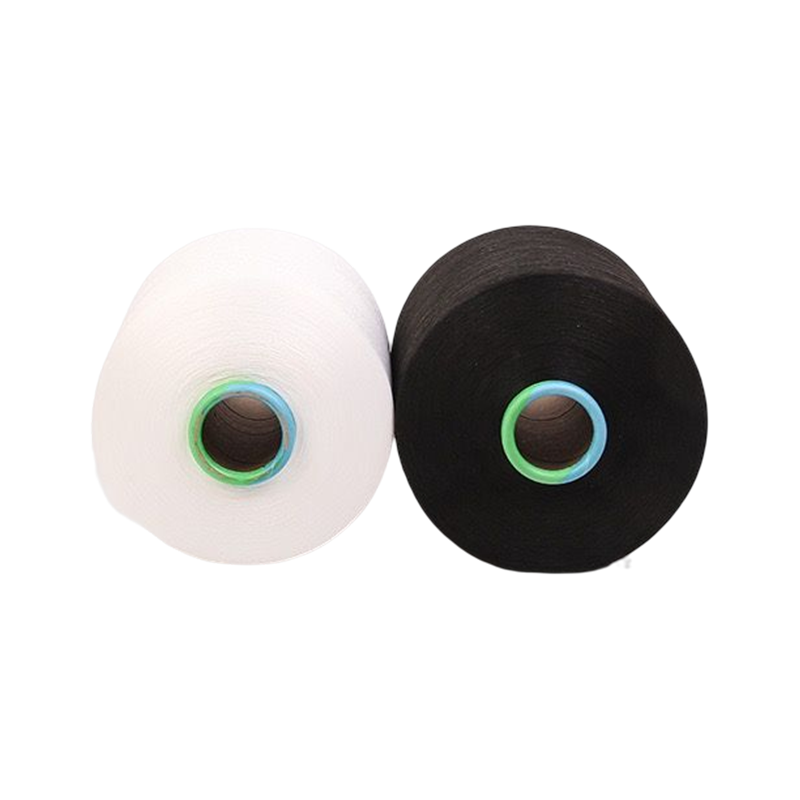
-2.png "Antibacterial and anti-odorant polyester DTY yarn White/Grey ZY0050-ZY0238FM")
-3.png "Wash-resistant and wear-resistant polyester DTY yarn Yellow/Grey/White ZY0076-ZY0334 178")
-2.png "Anti-wrinkle and antibacterial polyester DTY yarn Green Series ZG0136 Grass Green 084")
-2.png "High-performance environmentally friendly polyester DTY yarn Brown Series ZN0085 FM")
-2.png "Lightweight soft polyester DTY yarn Light Pink/Red/White/Purple/Yellow ZR0161-ZR0313 758")
-3.png "Full-color custom polyester DTY yarn Silver Series ZE0006-ZE0668 121")
-2.png "High elastic environmentally friendly polyester DTY yarn Blue Series ZB0118 350")
