
 English
 Español


Article Directory
- 1 What Is Draw Textured Yarn Used For in Textile Manufacturing
- 2 How Is Draw Textured Yarn Produced From Polyester POY
- 3 What Are the Advantages of Draw Textured Yarn in Fabric Production
- 4 How Draw Textured Yarn Improves Fabric Elasticity and Comfort
- 5 What Is the Difference Between Draw Textured Yarn and Flat Filament Yarn
- 6 Can Draw Textured Yarn Be Used for Knitting and Weaving
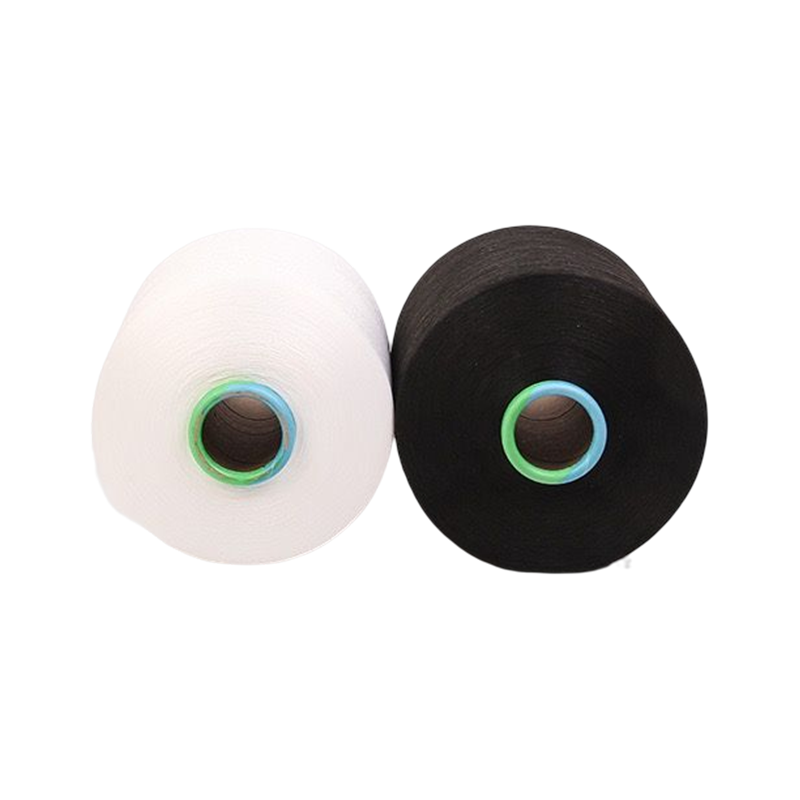
Draw textured yarn (DTY) is the finished polyester yarn type that powers the majority of the world's knitted apparel, activewear, and stretch fabric production. Produced by simultaneously drawing and false-twist texturing partially oriented yarn (POY), DTY acquires a permanent helical crimp in every filament — transforming a flat, low-elongation precursor into a bulky, elastic, soft yarn capable of delivering stretch, cover, and comfort in fabrics that rigid flat filament yarns cannot replicate. This guide covers DTY's industrial applications, production process, technical advantages, elasticity mechanics, comparison with flat filament yarn, and suitability for knitting and weaving.
What Is Draw Textured Yarn Used For in Textile Manufacturing
Draw textured yarn is used wherever fabric requires simultaneous softness, bulk, stretch recovery, and colour depth that flat polyester filaments cannot deliver. Its crimped filament structure creates air pockets within the yarn bundle that trap warmth, scatter light to reduce synthetic sheen, and allow the yarn to elongate and recover under body movement — properties that define performance in the largest fabric categories by volume.
In circular knitting — which accounts for over 60% of global DTY consumption — the yarn's crimped structure allows the needle to knit at lower tension than flat filament yarn, reducing needle breakage rate by 30 to 50% on high-speed machines. This mechanical benefit is rarely cited in product literature but is a primary reason knitting mills specify DTY even for applications where stretch is not a fabric requirement.
How Is Draw Textured Yarn Produced From Polyester POY
DTY production takes place on a false-twist texturing machine — a device that simultaneously draws the POY to its final molecular orientation and imparts a permanent helical crimp through a controlled twist-heat-untwist sequence. The entire process occurs in a single continuous pass at machine speeds of 600 to 1,000 metres per minute.
POY packages are loaded onto the machine creel and fed through ceramic thread guides into the entry zone at a controlled overfeed rate of 1.02 to 1.08 times the machine delivery speed. This small overfeed prevents tension breaks at entry while maintaining the consistent feed tension critical for uniform crimp development.
The POY passes over a contact heater or non-contact radiant heater set between 160 and 220°C depending on denier, machine speed, and target crimp geometry. Heat raises the yarn above its glass transition temperature (approximately 67°C for PET), softening the semi-crystalline structure sufficiently for plastic deformation during the twist phase immediately downstream.
A friction disc assembly — typically three polyurethane discs arranged in a crossed configuration — applies 1,800 to 3,200 twists per metre simultaneously with the draw tension. The twist propagates upstream into the heated zone where it is set by the heater, then completely untwisted downstream of the spindle. The result is a permanently crimped filament with helical geometry locked in by crystallisation during heating.
An optional second heater operating at 130 to 180°C under controlled low tension reduces the yarn's residual torque — the tendency of the crimped yarn to rotate when under low tension, which causes snarling during knitting. DTY without a second heater is termed "high-elastic DTY"; with second heating it is "set DTY" or "low-elastic DTY", each suited to different downstream applications.
An air-entanglement jet consolidates the individual filaments into periodic cohesion points — typically 60 to 120 interlace nodes per metre — replacing twist as the means of yarn integrity. Interlaced DTY processes more cleanly on knitting machines with yarn feeders that require a coherent yarn bundle rather than a loose crimped structure.
Finished DTY is wound onto a cheese or cone package at 600 to 1,000 m/min under precision traverse winding. Package hardness — controlled by the winding tension and traverse pattern — is critical: over-hard packages compress crimp; under-hard packages produce ribbon winding defects. DTY packages are inspected for denier CV%, crimp contraction value, and shade number before shipment.
What Are the Advantages of Draw Textured Yarn in Fabric Production
DTY delivers six structural advantages in fabric production that derive directly from its crimped filament geometry. Each advantage is a consequence of the helical crimp architecture — not of chemical treatment or fibre blending — making the benefits inherent and permanent across the yarn's service life.
How Draw Textured Yarn Improves Fabric Elasticity and Comfort
DTY improves fabric elasticity through a purely mechanical mechanism — the helical crimp acts as a molecular-scale spring. When tension is applied along the yarn axis, crimp amplitude decreases as filaments straighten; when tension is released, the thermally set crimp geometry drives recovery. No elastic fibre blending or chemical finishing is required to achieve this behaviour.
- Crimp contraction value: 35 – 55%
- Stretch recovery: 85 – 95% after 50% extension
- Residual torque: High — requires S and Z twist balancing in fabric construction
- Best for: Activewear, swimwear, compression hosiery, elastic waistbands
- Knitting note: Requires yarn feeder with positive delivery to manage torque snarling
- Crimp contraction value: 12 – 28%
- Stretch recovery: 70 – 85% after 30% extension
- Residual torque: Low — processes freely on standard knitting machines
- Best for: Fleece, home textiles, woven stretch, knitted outerwear
- Knitting note: Compatible with all feeder types; preferred for wider needle gauges
The comfort contribution of DTY in next-to-skin fabrics is not softness alone — it is the combination of low contact pressure from the crimped, bulky yarn surface and the fabric's ability to move with the body without generating restrictive counter-tension. A fabric that stretches 25% under arm movement and recovers fully on release eliminates the localised pressure points that cause discomfort fatigue over extended wear periods. DTY delivers this without the cost premium of elastane blending.
What Is the Difference Between Draw Textured Yarn and Flat Filament Yarn
Flat filament yarn — primarily FDY (fully drawn yarn) — and DTY are produced from the same PET polymer and share denier specifications, yet perform so differently in fabric that they are rarely interchangeable in a given construction. The difference originates entirely in the crimped filament geometry of DTY versus the straight, parallel filament alignment of FDY.
| Property | Draw Textured Yarn (DTY) | Flat Filament Yarn (FDY) |
| Filament geometry | Helical crimp, coiled structure | Straight, parallel alignment |
| Tenacity (cN/dtex) | 2.8 – 3.8 | 4.0 – 5.2 |
| Elongation at break | 20 – 35% (high-elastic: up to 50%) | 18 – 30% (non-elastic) |
| Bulk (yarn volume) | High — 2 to 3× flat equivalent | Low — compact filament bundle |
| Fabric appearance | Matte to semi-matte, diffuse lustre | Bright, high lustre, clean surface |
| Hand feel | Soft, warm, cotton-like | Smooth, cool, silky |
| Dye depth | Deep, saturated colour | Bright but less saturated |
| Primary application | Knitting, stretch weave, fleece | Fine woven: chiffon, georgette, taffeta |
| Knitting suitability | Excellent — preferred yarn type | Limited — high needle load, breakage risk |
The choice between DTY and FDY is therefore a fabric design decision, not a quality hierarchy. Georgette and chiffon require FDY's smooth, flat filament to achieve their characteristic drape and translucency — DTY would produce an unacceptably opaque, bulky fabric. Conversely, a fleece or activewear fabric engineered from FDY would be dense, rigid, and uncomfortable — DTY's crimp is what makes those constructions viable.
Can Draw Textured Yarn Be Used for Knitting and Weaving
Draw textured yarn is fully suitable for both knitting and weaving, with knitting representing the dominant application by volume and weaving being the growing secondary market. The suitability conditions and optimal DTY specifications differ between the two processes — specifying the same DTY grade for both applications without adjustment produces suboptimal results in at least one of them.
For warp use in weaving, DTY requires sizing or a higher interlace density (140+ nodes/m) to withstand the abrasion and cyclic tension of warp shedding — unsized, low-interlace DTY in the warp position on a high-speed loom produces filamentation and weaving stops within the first few hundred metres. FDY remains the preferred warp yarn in most commercial constructions; DTY's weaving strength lies in the weft.
-2.png "Antibacterial and anti-odorant polyester DTY yarn White/Grey ZY0050-ZY0238FM")
-2.png "Lightweight soft polyester DTY yarn Light Pink/Red/White/Purple/Yellow ZR0161-ZR0313 758")
-3.png "Wash-resistant and wear-resistant polyester DTY yarn Yellow/Grey/White ZY0076-ZY0334 178")
-3.png "Full-color custom polyester DTY yarn Silver Series ZE0006-ZE0668 121")
-2.png "High elastic environmentally friendly polyester DTY yarn Blue Series ZB0118 350")
-2.png "Anti-wrinkle and antibacterial polyester DTY yarn Green Series ZG0136 Grass Green 084")
-2.png "Multifunctional Environmentally friendly recycled polyester DTY yarn Purple ZP0471-ZP0566 306")
